
Criminal Law in Pakistan: 12 Mistakes That Instantly Weaken Your Case (2026)
A Comprehensive Guide to Navigating Pakistan’s Criminal Justice System
Last Updated: January 2026 | Reading Time: 12 minutes
Criminal law in Pakistan can be complex and unforgiving. Many defendants lose their cases because of simple, avoidable mistakes. This comprehensive guide explores the critical errors that can cost you your case and how to avoid them.
Whether you face charges under the Pakistan Penal Code (PPC), Criminal Procedure Code (CrPC), or any other criminal legislation, understanding these mistakes can make the difference between conviction and acquittal.
Understanding Criminal Law in Pakistan
Criminal law is different from civil law. Criminal law in Pakistan operates under a framework inherited from British common law. The system combines statutory laws, case precedents, and Islamic principles.
Legal Framework of Criminal Law in Pakistan
The primary legislation includes:
• Pakistan Penal Code (PPC) 1860
• Code of Criminal Procedure (CrPC) 1898
• Qanun-e-Shahadat Order 1984 (Evidence Law)
• Anti-Terrorism Act 1997
• Prevention of Electronic Crimes Act (PECA) 2016
Criminal proceedings in Pakistan follow an adversarial system. The prosecution must prove guilt beyond a reasonable doubt. Defense lawyers play a crucial role in protecting defendants’ rights.
Key Stakeholders in Pakistani Criminal Justice
Understanding who handles criminal cases helps you navigate the system better. The main players include:
• Police officers – investigate crimes and file FIRs
• Public prosecutors – represent the state in criminal trials
• Defense advocates – protect the accused’s legal rights
• Trial judges – preside over criminal proceedings
• High Court judges – hear appeals and constitutional petitions
Common Mistakes That Can Cost You Your Criminal Case
Most people accused of crimes make critical errors that harm their defense. These mistakes often stem from ignorance, panic, or bad advice. Let’s examine each mistake in detail.
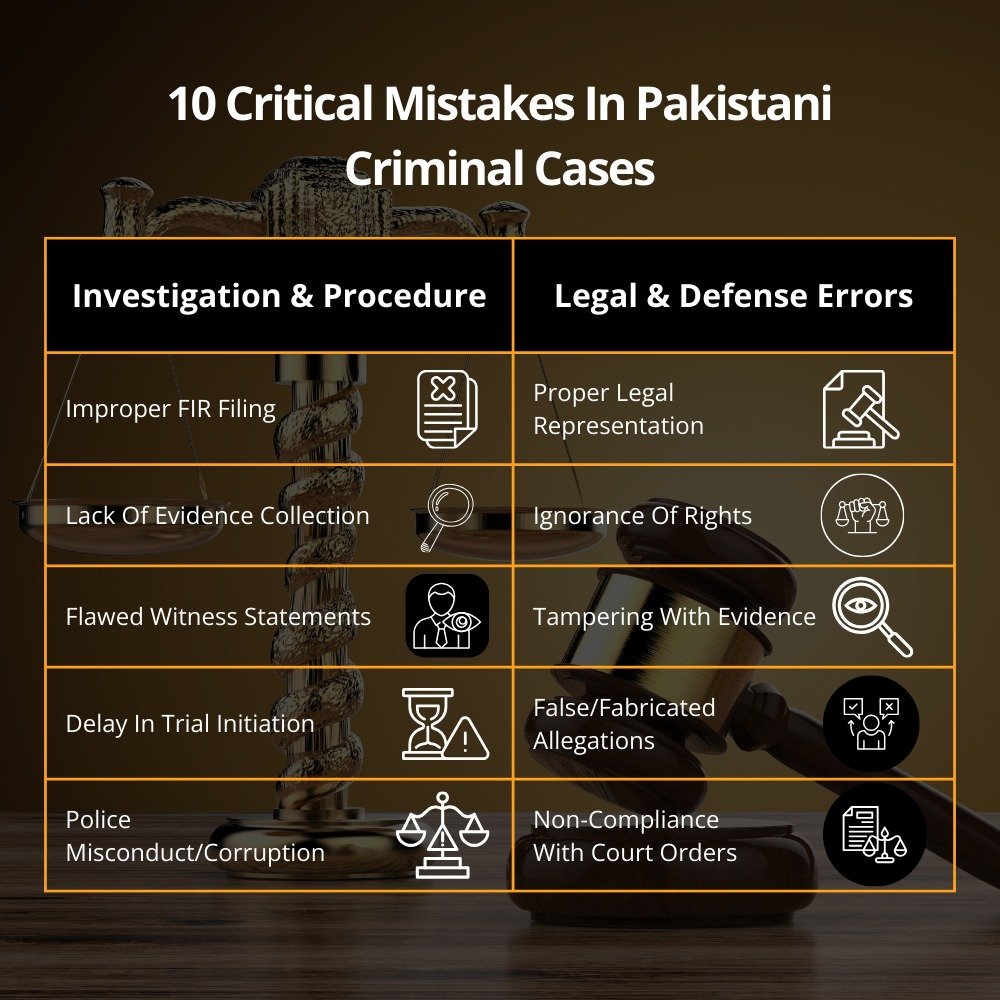
1. Delaying Legal Representation in Criminal Cases in Pakistan
Many accused persons wait too long before hiring a criminal defense lawyer. This delay proves costly. Evidence gets lost. Witnesses disappear. The prosecution builds a stronger case.
Why immediate legal help matters:
• Lawyers protect your rights during police interrogation
• Early evidence preservation strengthens your defense
• Quick bail applications prevent prolonged detention
• Experienced advocates identify weaknesses in the prosecution’s case
The first 72 hours after arrest are crucial. Contact a criminal lawyer immediately to protect your constitutional rights under Article 10 of Pakistan’s Constitution.
2. Talking to Police Without a Criminal Defense Lawyer
Your statements to the police can be used against you. A criminal defence lawyer is very crucial to contact before giving any statement to the police. Many accused persons think they can talk their way out of trouble. This rarely works. Instead, they provide evidence that prosecutors use to secure convictions.
What you should do:
• Exercise your right to remain silent
• Request a lawyer before any questioning
• Never sign documents without legal review
• Avoid voluntary statements that could be misconstrued
Under Section 164 CrPC, confessions made to police officers are generally inadmissible. However, anything you say can shape the investigation and prosecution strategy.
3. Ignoring FIR Details in Criminal Law Cases in Pakistan
The First Information Report (FIR) forms the foundation of any criminal case in Pakistan. Many defendants fail to review it carefully. This proves disastrous.
An FIR filed under the PPC sections defines the charges against you. It contains allegations, witness statements, and preliminary evidence. Errors or false statements in the FIR can be challenged.
Critical FIR review points:
• Check dates and timelines for inconsistencies
• Verify witness names and statements
• Identify factual errors that contradict evidence
• Note the delayed registration that suggests fabrication
• Document any missing mandatory FIR components
4. Missing Court Dates in Criminal Proceedings in Pakistan
Absent defendants face serious consequences. Courts issue arrest warrants. Bail gets cancelled. The case proceeds without your defense being heard.
The Criminal Procedure Code requires defendants to appear at all scheduled hearings. Judges view absences as disrespect or admission of guilt.
Always attend court unless you have:
• Medical emergency with proper documentation
• Pre-approved exemption from your lawyer
• Valid legal reason accepted by the court
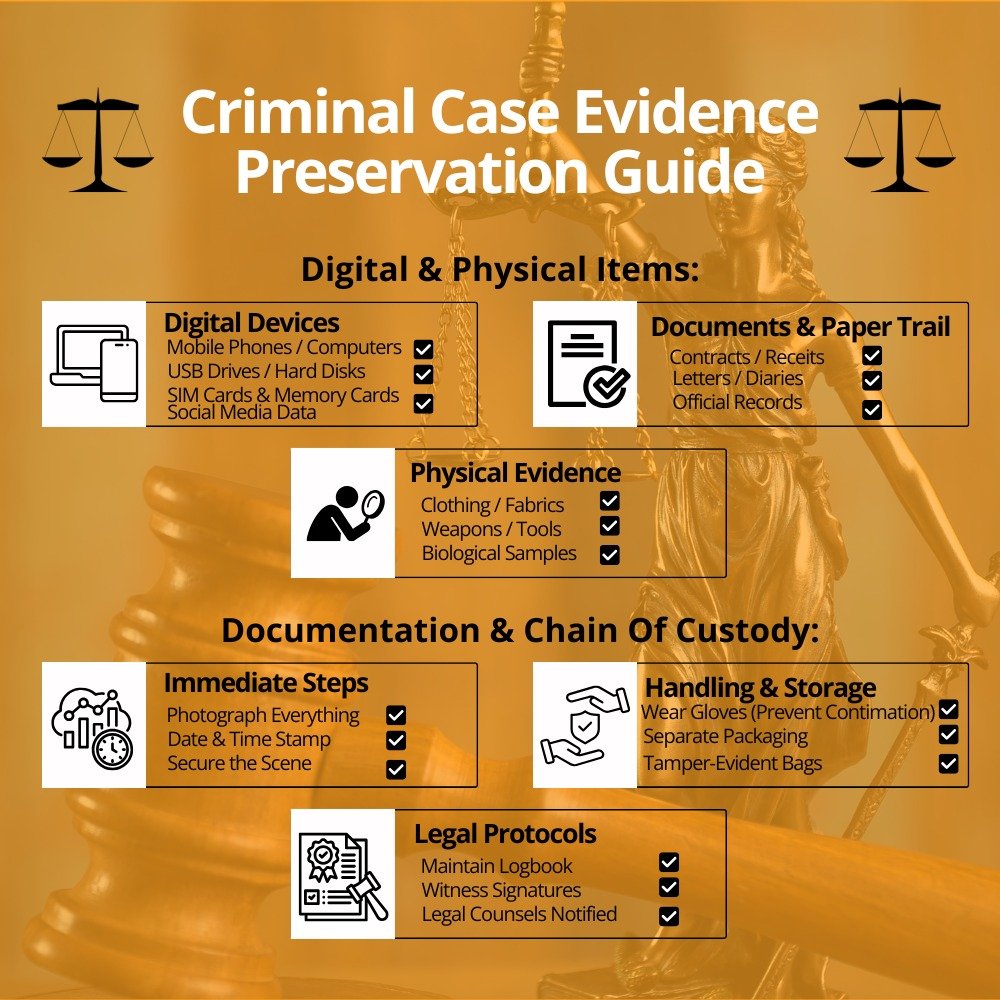
5. Failure to Preserve Evidence in Criminal Cases in Pakistan
Evidence wins cases. Many defendants fail to collect and preserve evidence that could prove their innocence. Time destroys evidence. Memories fade. Documents get lost.
Types of evidence to preserve:
• Digital records (emails, messages, call logs)
• CCTV footage from relevant locations
• Photographs of scenes, injuries, or property
• Medical reports and treatment records
• Witness contact information and statements
• Financial records and transaction receipts
6. Choosing an Inexperienced Criminal Lawyer in Pakistan
Criminal defense requires specialized expertise. General practice lawyers often lack the courtroom experience needed for criminal trials. Your freedom depends on skilled legal representation.
Look for these qualifications:
• Proven track record in criminal law cases
• Experience with specific charges you face
• Strong knowledge of PPC and CrPC procedures
• Active High Court and Supreme Court practice
• Positive client reviews and professional reputation
7. Not Understanding Bail Laws and Procedures in Pakistan
Bail keeps you out of jail during trial. Many defendants fail to apply properly. Others violate bail conditions and face re-arrest.
Pakistan’s criminal justice system recognizes different types of bail. Bailable offenses allow automatic bail. Non-bailable offenses require court discretion.
Bail application requirements:
• File within prescribed time limits
• Present surety bonds as required
• Demonstrate ties to the community
• Show low flight risk
• Comply strictly with all bail conditions
8. Discussing Criminal Cases Publicly or on Social Media
Social media posts destroy defenses. Public statements provide evidence to prosecutors. Witnesses quote your words against you in court.
What to avoid:
• Posting about your case on social media
• Discussing details with friends or family
• Giving media interviews without lawyer approval
• Confronting witnesses or complainants
9. Ignoring Plea Bargain Options Under CrPC in Pakistan
Plea bargaining under Section 265-K CrPC offers reduced sentences. Some defendants reject reasonable deals and face harsher penalties after trial.
Consider plea bargaining when:
• Evidence strongly supports prosecution
• The offered sentence significantly reduces punishment
• Trial carries substantial conviction risk
• Quick resolution serves your interests
Always consult your defense lawyer before accepting any plea deal. Understand all consequences before signing agreements.
10. Improper Witness Preparation in Criminal Trials in Pakistan
Defense witnesses strengthen your case. Unprepared witnesses damage it. Their testimony must be consistent, credible, and helpful.
Witness preparation steps:
• Review their statements with your lawyer
• Practice courtroom testimony procedures
• Ensure witnesses understand cross-examination
• Prepare them for prosecution tactics
11. Violating Court Orders in Criminal Cases in Pakistan
Court orders must be followed strictly. Violations lead to contempt charges, bail cancellation, and adverse inferences. Stay within geographical boundaries. Report as directed. Avoid contact with restricted persons.
12. Failure to Challenge Illegal Evidence in Criminal Law Cases
Evidence obtained illegally should be excluded. Challenge unlawful searches under Article 9 of the Constitution. Question coerced confessions. Object to improperly handled physical evidence. Your lawyer must file appropriate motions.
Constitutional Rights of Accused Under Criminal Law in Pakistan
Pakistan’s Constitution guarantees fundamental rights to all accused persons. These protections form the bedrock of criminal defense.
Article 10 – Safeguards as to Arrest and Detention
• Right to know the grounds of arrest
• Right to legal counsel
• Right to be produced before a magistrate within 24 hours
• Protection against illegal detention
Article 13 – Protection Against Double Jeopardy
You cannot be prosecuted and punished twice for the same offense. This protection prevents repeated trials for the same criminal act.
Article 14 – Right to Fair Trial in Pakistan
• Presumption of innocence until proven guilty
• Right to defend yourself in person or through counsel
• Right to examine witnesses against you
• Right to call witnesses in your defense
Criminal Procedure in Pakistan Under CrPC (Criminal Procedure)
Criminal proceedings follow structured procedures under the CrPC. Understanding each stage helps you participate effectively in your defense.
Investigation Stage in Criminal Cases in Pakistan
Police investigate offenses after FIR registration. They collect evidence, record statements, and submit reports. This stage typically lasts 14 days but can be extended.
Key investigation procedures:
• FIR lodged at police station (Section 154 CrPC)
• Police record witness statements (Section 161 CrPC)
• Evidence collection and preservation
• Investigation report submitted to the magistrate
Criminal Trial Process in Pakistan
Criminal trials proceed before sessions courts or magistrates. The prosecution presents its case first. Defense follows. The judge evaluates evidence and delivers judgment.
Trial phases:
1. Framing of charges – The Court formally charges the accused
2. Prosecution evidence – State presents witnesses and documents
3. Statement under Section 342 CrPC – Accused explains charges
4. Defense evidence – Defense presents its case
5. Final arguments – Both sides present legal arguments
6. Judgment – Court announces verdict and sentence
Criminal Appeal Process in Pakistan
Convictions can be appealed to higher courts. The appeal must identify legal errors or procedural violations. Time limits apply strictly.
Appeal hierarchy:
• Sessions Court judgments → High Court
• High Court judgments → Supreme Court
• The Supreme Court is the final appellate authority
Commonly Prosecuted Offenses Under the Pakistan Penal Code
Understanding specific PPC sections helps you recognize charges and potential defenses. Here are frequently prosecuted offenses.
| PPC Section | Offense | Maximum Punishment |
| 302 | Murder (Qatl-e-Amd) | Death or life imprisonment |
| 324 | Attempt to murder | 14 years imprisonment |
| 376 | Rape | Death or life imprisonment |
| 379 | Theft | 3 years imprisonment |
| 392 | Robbery | Life imprisonment |
| 420 | Cheating and fraud | 7 years imprisonment |
| 489-F | Dishonored cheque | 3 years imprisonment |
| 498-A | Enticing married woman | 7 years imprisonment |
When to Hire a Criminal Defense Lawyer in Pakistan
Timing matters in criminal defense. Early legal intervention provides better outcomes. Here are situations requiring immediate legal help.
Before Police Questioning
Contact a lawyer before speaking to the police. They protect your constitutional rights during interrogation. Never answer questions without legal counsel present.
Upon Receiving Police Notice
Police notices under Section 160 CrPC require your appearance. Consult a lawyer immediately. They assess the situation and protect your interests.
When FIR is Registered
An FIR against you triggers formal proceedings. Hire experienced defense counsel immediately. They can apply for bail and challenge false allegations.
During the Investigation Phase
Legal representation during an investigation preserves your rights. Lawyers ensure proper procedures. They gather evidence and identify prosecution weaknesses early.
Criminal Defense Lawyer Fees and Legal Costs in Pakistan
Criminal defense costs vary by case complexity. Factors include offense severity, trial duration, and required appeals. Many lawyers offer payment plans.
Cost considerations:
• Initial consultation fees
• Retainer agreements
• Court appearance charges
• Document preparation fees
• Appeal stage costs
Role of Criminal Lawyers in Protecting Legal Rights in Pakistan
Skilled criminal defense lawyers provide comprehensive protection. Their expertise covers investigation, trial, and appeals. They fight to secure the best possible outcome.
Legal Research and Case Analysis
Lawyers analyze case law and legal precedents. They identify applicable defenses and procedural errors. This research forms the foundation of your defense strategy.
Evidence Collection and Witness Preparation
Defense counsel gathers exculpatory evidence. They interview witnesses and prepare testimony. Professional investigation services may be employed.
Negotiation with Prosecutors
Experienced lawyers negotiate favorable terms. They may secure reduced charges or alternative sentences. Good relationships with prosecutors benefit clients.
Trial Representation
Courtroom advocacy requires skill and experience. Lawyers cross-examine witnesses effectively. They present persuasive arguments and protect procedural rights.
Appeals and Post-Conviction Relief
Criminal lawyers handle appeals to higher courts. They identify legal errors and constitutional violations. Post-conviction remedies may reduce sentences or overturn convictions.
Legal Resources for Criminal Law in Pakistan
Access authoritative legal resources to understand Pakistan’s criminal justice system better. These external references provide comprehensive information.
1. Pakistan Penal Code – National Assembly Legislative Database – Official source for complete PPC text and amendments
2. Supreme Court of Pakistan – Case Law Database – Access landmark criminal law judgments and precedents
3. Pakistan Bar Council – Find Legal Representation – Official directory of licensed advocates and legal professionals
These resources provide authentic legal information. Always consult qualified criminal lawyers for specific legal advice regarding your case.
How Qadir Chambers Handles Criminal Law Cases in Pakistan
Facing criminal charges requires experienced legal representation. Qadir Chambers brings decades of specialized expertise in Pakistan’s criminal justice system. Our team understands the complexities of criminal law and fights to protect your constitutional rights at every stage.
Our Comprehensive Criminal Defense Services:
● Immediate Legal Intervention – We respond within hours of your call. Our bail lawyers protect your rights during police interrogation and secure your release through bail applications.
● FIR Analysis and Challenges – We meticulously examine every FIR for inconsistencies, procedural violations, and false allegations. Our team files successful applications to quash fabricated FIRs.
● Strategic Defense Planning – Our advocates develop comprehensive defense strategies tailored to your specific charges. We identify weaknesses in prosecution cases and build strong defenses.
● Evidence Preservation and Investigation – We act quickly to preserve crucial evidence. Our team collects digital records, secures CCTV footage, interviews witnesses, and gathers documentation supporting your innocence.
● Trial Representation – Our experienced trial lawyers provide aggressive courtroom advocacy. We cross-examine prosecution witnesses effectively, present compelling arguments, and challenge illegal evidence.
● Appeals and Post-Conviction Relief – If convicted, we file comprehensive appeals to the High Courts and the Supreme Court. Our appellate lawyers identify legal errors and constitutional violations to overturn wrongful convictions.
Why Choose Qadir Chambers?
• Proven Track Record – Our firm has successfully defended clients in thousands of criminal cases across Pakistan, from district courts to the Supreme Court.
• Specialized Criminal Law Expertise – Unlike general practice lawyers, we focus exclusively on criminal defense. Our team has deep knowledge of PPC, CrPC, and criminal procedure.
• Client-Centered Approach – We believe in treating every client with dignity and respect. Your satisfaction and freedom are our top priorities.
• 24/7 Availability – Criminal emergencies don’t follow business hours. Our team is available around the clock to respond to your legal needs.
• Transparent Communication – We keep you informed at every stage. You’ll understand your case, your options, and our strategy in clear, simple language.
• Affordable Fee Structures – Quality legal defense shouldn’t be unaffordable. We offer transparent pricing and flexible payment plans to make our services accessible.
“Ignorance of the law is no excuse.” At Qadir Chambers, we believe in empowering clients through legal knowledge. Our commitment extends beyond courtroom advocacy to educating and guiding you through every step of your legal journey. Your candor and trust enable us to build the strongest possible defense.
Contact Qadir Chambers today for a confidential consultation. Don’t let avoidable mistakes cost you your freedom. Our experienced criminal defense team stands ready to protect your rights and fight for your future.
Conclusion: Avoiding Costly Mistakes in Criminal Law Cases in Pakistan
Criminal law in Pakistan presents complex challenges. The mistakes discussed here cost defendants their freedom. Avoid these errors to protect your rights.
Early legal representation makes a difference. Experienced criminal defense lawyers navigate the system effectively. They preserve evidence, challenge prosecution cases, and defend your constitutional rights.
Remember these key takeaways: hire a lawyer immediately, never speak to police without counsel, understand your FIR completely, attend all court dates, and preserve all evidence. Follow your lawyer’s advice strictly.
Your freedom and future depend on proper legal defense. Don’t let avoidable mistakes cost you your case. Act quickly, hire competent counsel, and fight for justice.
If you face criminal charges, contact an experienced criminal defense lawyer today. Early intervention protects your rights and improves your chances of a favorable outcome.
Disclaimer: This article provides general information about criminal law in Pakistan. It does not constitute legal advice. Every criminal case has unique circumstances requiring professional legal analysis. Consult qualified criminal defense lawyers for advice specific to your situation.
FAQs
What should I do immediately after an arrest?
Contact a criminal defense lawyer immediately. Exercise your right to remain silent. Do not sign any documents without legal review. Request that the police inform your family of your detention. Remember, you have constitutional rights under Article 10 that protect you from illegal detention and ensure access to legal counsel.
Can I be denied bail in Pakistan?
Yes. Bail depends on the offense type. Bailable offenses allow automatic bail. Non-bailable offenses require court discretion. Factors include offense severity, flight risk, evidence strength, and criminal history. Serious crimes like murder under PPC Section 302 or terrorism charges often result in bail denial. However, courts can grant bail even in non-bailable offenses under exceptional circumstances.
How long does a criminal trial take in Pakistan?
Trial duration varies significantly. Simple cases may conclude in 6-12 months. Complex cases involving multiple accused or serious charges can take 2-5 years. Delays occur due to witness unavailability, adjournments, court backlogs, and procedural matters. The criminal justice system aims for speedy trials under Article 10-A, but practical realities often extend timelines.
Can I change my lawyer during trial?
Yes, you have the right to change counsel at any stage. However, frequent changes can harm your case. New lawyers need time to review files and understand proceedings. Courts may grant brief adjournments for new counsel preparation. Choose your lawyer carefully from the start to avoid disruptions during critical trial phases.
What is the difference between cognizable and non-cognizable offenses?
Cognizable offenses are serious crimes where police can arrest without a warrant and investigate without a magistrate’s permission. Examples include murder, rape, robbery, and kidnapping. Non-cognizable offenses are less serious crimes requiring a magistrate’s permission for police investigation. Examples include assault, defamation, and certain property disputes. This classification affects police powers and procedural requirements.
Can a false FIR be challenged in court?
Yes, false FIRs can be challenged through multiple remedies. You can file for FIR cancellation under Section 561-A CrPC before the High Court. Alternatively, seek quashing of FIR under constitutional jurisdiction. Present evidence proving malicious prosecution, factual impossibilities, or legal deficiencies. Courts examine whether allegations constitute an offense and whether evidence supports charges.
What happens if I miss a court hearing or trial date?
Missing court dates has serious consequences. The court may issue non-bailable warrants for your arrest. Your bail can be cancelled. The case may proceed ex parte (without your presence). Judges view absences negatively. Always attend scheduled hearings. If genuinely unable to appear, have your lawyer file an application explaining the reasons with supporting documents like medical certificates.
Can criminal records be expunged in Pakistan?
Pakistan has limited expungement provisions. Some courts grant expungement for minor offenses after a substantial time has passed. Juvenile records may receive special consideration. Presidential pardons under Article 45 can remove criminal liability but typically do not erase records. Consult legal counsel about specific relief available for your situation and jurisdiction.
What is a compoundable offense under criminal law?
Compoundable offenses can be settled between parties without the need for a court trial. Section 345 CrPC lists compoundable offenses. Some require court permission for compounding. Others allow private settlement. Examples include simple hurt, criminal breach of trust, and defamation. Serious crimes like murder, rape, and robbery are non-compoundable. Compounding offers quicker resolution and avoids trial publicity.