10 Fundamental Differences Between Civil and Criminal Law that Every Pakistani Should Know in 2026
Understanding the difference between civil and criminal law is essential for every citizen. These two legal systems serve different purposes. They follow different procedures. They result in different outcomes.
This comprehensive guide clearly explains civil law and criminal law. You will learn how these legal systems work in Pakistan. You will understand when each applies to your situation.
Many people confuse civil and criminal cases. This confusion can lead to wrong legal actions. Knowing the difference helps you protect your rights effectively.
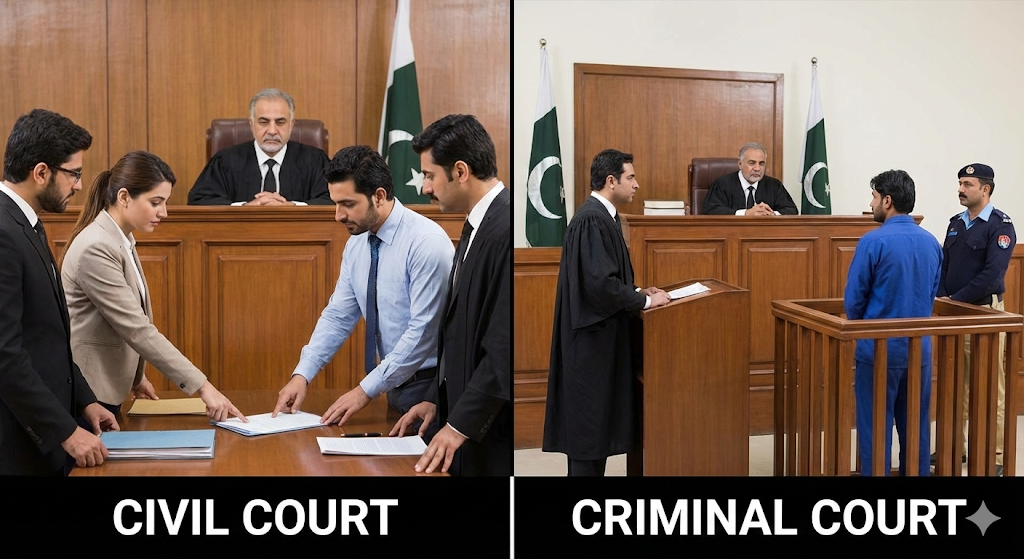
[IMAGE SUGGESTION 1: Split image showing civil court scene on left (judge with two disputing parties) and criminal court scene on right (judge with prosecutor and defendant).
What Is the Difference Between Civil and Criminal Law in Pakistan?
The primary distinction between civil and criminal law lies in their fundamental purposes. Civil law resolves disputes between individuals or organizations. Criminal law punishes offenses against society.
These two legal systems operate independently in Pakistan. Each has its own courts, procedures, and legal standards. The outcomes they produce affect people in different ways.
Your choice between civil and criminal law depends on the nature of harm. Financial losses typically require civil action. Crimes against public order require criminal prosecution. Understanding this distinction is the first step to seeking proper justice.
Key Concept: Civil law seeks compensation. Criminal law seeks punishment.
Both systems differ in purpose, procedures, proof standards, and outcomes. Understanding these differences enables you to navigate legal challenges more effectively. Let’s explore each system in detail.
What Is Civil Law in Pakistan?
Civil law governs disputes between private parties. These parties can be individuals, businesses, or organizations. Civil cases involve disagreements over rights, obligations, or contracts.
The primary goal of civil law is to make the injured party whole again. Courts achieve this through monetary compensation or specific orders. Civil law does not focus on punishment.
Pakistan’s civil law system follows the Civil Procedure Code 1908. This code establishes how civil cases proceed through courts. Various special laws also govern specific civil matters like contracts and property.
Common civil law matters include:
• Contract disputes and breaches
• Property disagreements
• Personal injury claims
• Family law issues (divorce, custody)
• Employment disputes
• Debt recovery
Civil law aims to make the injured party whole. The remedy is usually monetary compensation. Sometimes courts order specific performance or injunctions.
What Is Criminal Law in Pakistan?
Criminal law deals with offenses against society. The state prosecutes criminal cases. Criminal law aims to maintain public order and safety.
When someone commits a crime, they violate social norms and laws. Society has an interest in punishing such conduct. The government, not the victim, takes action against the accused.
Pakistan’s criminal justice system operates under the Pakistan Penal Code 1860. The Code of Criminal Procedure 1898 governs how criminal cases proceed. These laws define crimes and prescribe punishments.
Common criminal offenses include:
• Murder and manslaughter
• Theft and robbery
• Assault and battery
• Fraud and financial crimes
• Drug offenses
• Sexual offenses
Criminal law punishes wrongdoers. Penalties include imprisonment, fines, or both. The goal is deterrence and rehabilitation.
Key Differences Between Civil and Criminal Law in Pakistan
This table summarizes the main differences between civil and criminal law. Each aspect reveals how these systems operate differently. Understanding these distinctions helps you choose the right legal path.
The differences affect everything from who files the case to what outcomes you can expect. Study this comparison carefully to understand which legal system applies to your situation.
| Objective | Civil Law | Criminal Law |
| Purpose | Resolve disputes between parties | Punish crimes against society |
| Who Files | Plaintiff (injured party) | State (prosecution) |
| Parties | Plaintiff vs Defendant | State vs Accused |
| Burden of Proof | Balance of probabilities | Beyond a reasonable doubt |
| Proof Required | 51% probability (more likely than not) | 99% certainty (no reasonable doubt) |
| Outcome | Liable or not liable | Guilty or not guilty |
| Penalties | Monetary damages, injunctions | Imprisonment, fines, death |
| Appeal Rights | Both parties can appeal | Defendant can appeal the conviction |
| Lawyer Required | Optional (but recommended) | Constitutional right to a lawyer |
| Examples | Breach of contract, divorce, negligence | Murder, theft, assault, fraud |
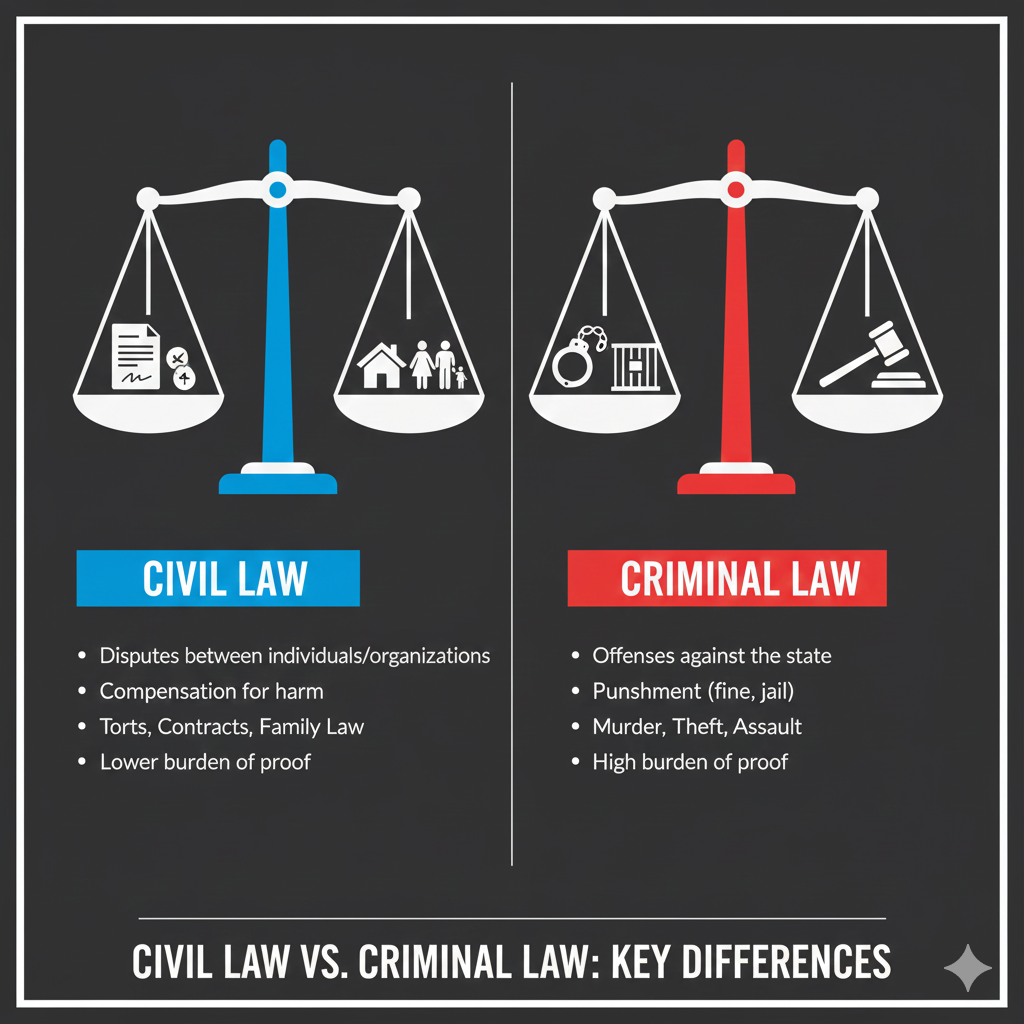
IMAGE 2: Infographic showing two scales of justice side by side. Left scale labeled ‘Civil Law’ with icons for contracts, property, family. Right scale labeled ‘Criminal Law’ with icons for handcuffs, prison, gavel.
10 Major Differences Between Civil and Criminal Law in Pakistan
Understanding these specific differences helps you determine which legal system applies to your situation. Each difference impacts how your case proceeds. Let’s examine each distinction in detail.
These ten differences form the foundation of Pakistan’s dual legal system. Knowing them empowers you to make informed legal decisions. They guide you toward the proper remedy for your situation.
1. Difference in Purpose Between Civil and Criminal Law
The fundamental difference between civil and criminal law lies in their objectives. Civil law aims to compensate victims. Criminal law aims to punish offenders.
This distinction shapes everything about how cases proceed. Civil courts focus on making victims financially whole. Criminal courts focus on protecting society through punishment and deterrence.
Your choice between systems depends on what outcome you seek. If you want money damages, civil law applies. If you want someone imprisoned, criminal prosecution is necessary.
Civil law objectives:
• Restore the injured party to the original position
• Provide monetary compensation
• Enforce private rights and obligations
Criminal law objectives:
• Deter criminal behavior
• Rehabilitate offenders
• Protect society from dangerous individuals
2. Difference in Purpose Between Civil and Criminal Law
Who initiates legal action differs significantly between civil and criminal law. This affects who controls the case. It determines who bears the costs.
In civil matters, the injured party decides whether to sue. They hire lawyers at their own expense. They can settle or drop the case anytime.
Criminal cases work differently. The state prosecutes even if the victim doesn’t want to proceed. Public prosecutors handle criminal cases. Victims cannot stop prosecution once it begins.
In civil law: The injured party (plaintiff) files the case. They hire their own civil lawyer. They bear the cost of litigation. They can settle or withdraw the case.
In criminal law: The state prosecutes through public prosecutors. The victim cannot withdraw the case. The state bears prosecution costs such as criminal lawyer expenses. Cases proceed regardless of the victim’s wishes.
3. Difference in Burden of Proof in Civil and Criminal Law
The burden of proof creates a major difference between civil and criminal law. This standard determines how much evidence you need. It directly affects your chance of winning.
Civil cases use a lower standard called the balance of probabilities. You must prove your claim is more likely true than false. This requires only 51% certainty.
Criminal cases require proof beyond a reasonable doubt. The prosecution must eliminate all reasonable doubts about guilt. This high standard protects innocent persons from wrongful conviction.
Civil law standard – Balance of Probabilities:
• Must prove claim is more likely true than false
• Requires 51% certainty
• Lower threshold makes proving easier
Criminal law standard – Beyond a Reasonable Doubt:
• Must prove guilt with near certainty
• Requires approximately 99% certainty
• Higher threshold protects innocent persons
Key Point: The same conduct can be proven in civil court but not criminal court due to different proof standards.
4. Difference in Punishments and Remedies
Penalties represent perhaps the most visible difference between civil and criminal law. Civil remedies focus on compensation. Criminal punishments focus on deprivation of liberty.
Civil courts cannot imprison defendants. They order monetary payments or specific actions. The goal is to restore the victim’s position, not punish the wrongdoer.
Criminal courts impose harsh punishments. These include imprisonment, fines, and in extreme cases, death. Criminal convictions create permanent records that affect future opportunities.
Civil law remedies:
• Compensatory damages – Money to cover actual losses
• Specific performance – Court orders to fulfill contracts
• Injunctions – Orders to stop harmful actions
• Declaratory relief – Court declarations about rights
Criminal law punishments:
• Imprisonment – Loss of freedom
• Fines – Monetary penalties to the state
• Death penalty – For the gravest offenses
• Criminal record – Permanent mark affecting future opportunities
5. Difference in Legal Rights in Civil and Criminal Law
Constitutional protections differ between civil and criminal law cases. Criminal defendants enjoy more extensive rights. Civil litigants have fewer constitutional safeguards.
The difference exists because criminal convictions carry severe penalties, including loss of liberty. Society recognizes the need for extra protection. Civil cases involve only property and monetary interests.
Pakistan’s Constitution guarantees fundamental rights to criminal defendants. These include the presumption of innocence and protection against self-incrimination. Civil litigants lack these special protections.
Rights in civil cases:
• Right to legal representation (must hire)
• Right to present evidence
• Right to appeal judgment
Additional rights in criminal cases:
• Presumption of innocence
• Right to remain silent
• Protection against self-incrimination
• Right to speedy trial
• Constitutional right to counsel
6. Difference in Trial Procedure: Civil vs Criminal Law
Trial procedures show significant differences between civil and criminal law. Criminal trials follow stricter rules. Civil proceedings allow more flexibility.
Civil trials focus on efficiency and resolution. Judges often encourage settlement. Parties can negotiate and compromise throughout proceedings.
Criminal trials protect defendants through formal procedures. Public trials ensure transparency. Strict evidence rules prevent wrongful convictions.
Civil trial features:
• Less formal proceedings
• Judge decides most cases
• Parties can settle anytime
• Discovery process extensive
Criminal trial features:
• Strict formal procedures
• Public trial requirement
• Stricter evidence rules
• Unanimous verdict often required
7. Difference in Case Outcomes in Civil and Criminal Cases
Case outcomes use different terminology in civil and criminal law. The language reflects each system’s purpose. Civil outcomes focus on liability. Criminal outcomes determine guilt.
Understanding outcome terminology helps you comprehend court decisions. Civil verdicts use ‘liable’ or ‘not liable.’ Criminal verdicts use ‘guilty’ or ‘not guilty.’
These terms carry different implications. Being found liable means owing money or performing obligations. Being found guilty means facing criminal punishment.
Civil case outcomes:
• Liable – Defendant responsible for damages
• Not liable – Defendant not responsible
Criminal case outcomes:
• Guilty – Convicted of a crime
• Not guilty – Acquitted of charges
8. Difference in Settlement Options Under Civil and Criminal Law
Settlement possibilities differ greatly between civil and criminal law. Civil cases encourage settlement. Criminal cases limit settlement options.
Most civil disputes are resolved through settlement before trial. Parties negotiate terms that satisfy both sides. Courts actively promote settlement through mediation.
Criminal cases protect public interest, limiting private settlements. The state cannot allow victims to sell justice. Only specific compoundable offenses permit settlement with court approval.
Civil cases: Parties can settle at any time. Most civil cases settle before trial. Settlements are private agreements. Courts encourage settlement.
Criminal cases: Limited settlement options. Plea bargaining is available in some cases. The victim cannot settle the prosecution. The court must approve any agreements.
9. Difference in Limitation Periods (Time Limits)
The statute of limitations varies between civil and criminal law. These time limits determine when you can file cases. Missing deadlines bars legal action forever.
Civil law imposes strict time limits on most claims. These limitations encourage prompt resolution of disputes. Delayed claims lose evidentiary quality.
Criminal law treats serious crimes differently. Murder and other grave offenses have no time limits. Society’s interest in punishing serious crimes never expires.
Civil law limitations:
• Typically 3-6 years for most claims
• Varies by claim type
• Can be extended in some cases
Criminal law limitations:
• No limitation for serious crimes
• Murder is prosecutable anytime
• Minor offenses have time limits
10. Difference in Legal Costs in Civil and Criminal Law
Financial implications differ between civil and criminal law cases. Civil litigation costs are borne by private parties. Criminal prosecution costs burden the state.
Civil plaintiffs are required to pay substantial fees upfront. These include lawyer fees, court charges, and expert witness costs. Losing parties often must pay the winner’s costs, too.
Criminal defendants pay only for their defense lawyers. The state funds prosecution at public expense. This ensures justice accessibility regardless of wealth.
Civil case costs:
• Plaintiff pays own lawyer fees
• Court filing fees required
• Loser may pay winner’s costs
Criminal case costs:
• State bears prosecution costs
• Defendant pays defense lawyer
• Legal aid available for indigents
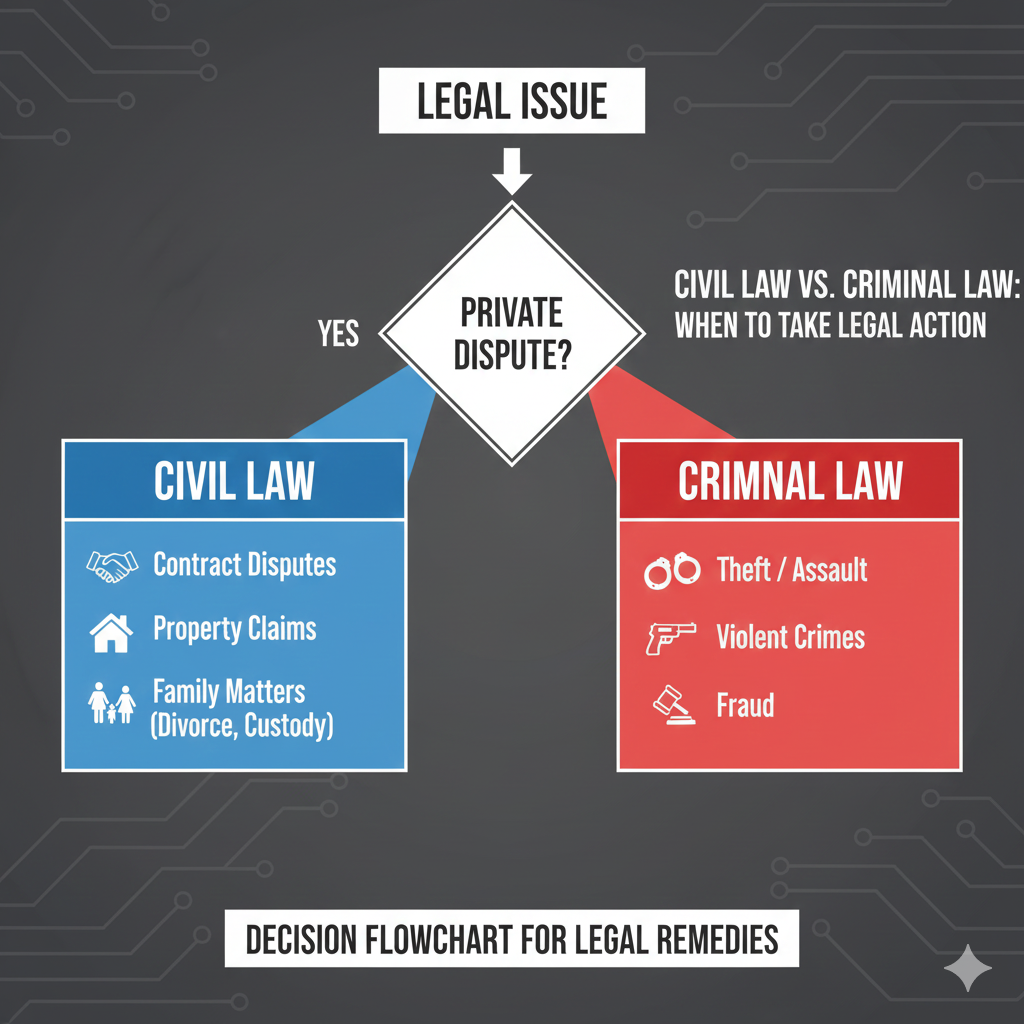
IMAGE SUGGESTION 3: Flowchart showing when to use civil law vs criminal law. Start with ‘Legal Issue’ at top, branching to ‘Private Dispute?’ (leads to Civil Law) and ‘Crime Against Society?’ (leads to Criminal Law). Include examples under each branch.
Can the Same Act Be Both a Civil and Criminal Offense in Pakistan?
Yes. The same wrongful act can violate both civil and criminal law. This represents an important difference between civil and criminal law systems – they operate independently.
One action can create two separate legal consequences. The criminal case seeks punishment through imprisonment or fines. The civil case seeks monetary compensation for damages.
Both cases proceed simultaneously in different courts. Criminal courts handle prosecution. Civil courts address compensation claims. Different judges decide each case independently.
Key Concept: One wrongful act can result in two separate legal cases – one civil, one criminal.
Example – Assault Case:
Criminal case: State prosecutes attacker for assault under PPC. Possible punishment: imprisonment. Purpose: to punish criminal behavior.
Civil case: Victim sues attacker for damages. Possible remedy: monetary compensation. Purpose: to compensate the victim’s losses.
Both cases proceed independently:
• Different judges hear each case
• Different standards of proof apply
• Outcomes can differ
• Criminal acquittal doesn’t prevent civil liability
Civil Law vs Criminal Law in Pakistan’s Legal System
Pakistan’s legal system clearly distinguishes between civil and criminal law. Each operates under separate codes and procedures. Understanding Pakistan’s specific framework helps you navigate the system.
Both systems have evolved over the decades since independence. They combine British common law traditions with Islamic legal principles. Modern civil and criminal law legislation continues to update these frameworks.
Civil Law Framework in Pakistan
Pakistan’s civil law system provides comprehensive coverage of private disputes. Multiple statutes govern different aspects of civil life. These laws protect property rights, enforce contracts, and resolve family matters.
Governing legislation:
• Civil Procedure Code (CPC) 1908
• Contract Act 1872
• Transfer of Property Act 1882
• Family laws and provincial legislation
Criminal Law Framework in Pakistan
Pakistan’s criminal justice system maintains public order and safety. The Pakistan Penal Code defines all major crimes. Procedural laws ensure fair trials and protect defendants’ rights.
Governing legislation:
• Pakistan Penal Code (PPC) 1860
• Code of Criminal Procedure (CrPC) 1898
• Specialized criminal laws (Anti-Terrorism Act, PECA, etc.)
When to Use Civil Law vs Criminal Law in Pakistan
Understanding when each legal system applies helps you take appropriate action. The nature of your problem determines which system to use. Choose wisely to get proper remedies.
Civil law addresses private wrongs requiring compensation. Criminal law addresses public wrongs requiring punishment. Sometimes, both systems apply to the same incident.
Use Civil Law When:
• Someone breaches a contract with you
• You suffer property damage from negligence
• You need divorce or custody orders
• Someone owes you money
• You suffer personal injury from negligence
• Property disputes arise
Use Criminal Law When:
• You’re a victim of a violent crime
• Property stolen from you
• You’re defrauded
• Someone threatens you
• Public safety endangered
Legal Help for Civil and Criminal Law Cases in Pakistan – Qadir Chambers
Understanding the difference between civil and criminal law is just the first step. Professional legal representation ensures your rights are protected in either system. Qadir Chambers provides expert guidance through both civil and criminal legal matters.
Our experienced team understands both legal systems thoroughly. We handle civil litigation from contract disputes to property matters. We provide criminal defense lawyer from the FIR stage through appeals.
Our civil law services:
• Contract dispute resolution
• Property litigation
• Personal injury claims
• Debt recovery
Our criminal law services:
• Criminal defense representation
• Bail applications
• FIR challenges
• Appeals and revisions
Contact Qadir Chambers today for expert legal guidance in civil or criminal matters.
Conclusion: Understanding the Difference Between Civil and Criminal Law in Pakistan
The difference between civil and criminal law affects every aspect of legal proceedings. Civil law resolves private disputes through compensation. Criminal law punishes public offenses through penalties.
These systems differ in purpose, procedures, proof standards, and outcomes. Understanding these differences helps you navigate legal challenges effectively. You now know when to use civil law versus criminal law.
Whether facing civil litigation or criminal charges, seek qualified legal counsel immediately. Professional lawyers protect your rights and achieve the best possible outcomes. Qadir Chambers provides expert guidance in both civil and criminal matters.
FAQs
What is the main difference between civil and criminal law?
The main difference between civil and criminal law is their purpose. Civil law resolves private disputes and provides compensation to injured parties. Criminal law prosecutes offenses against society and imposes punishment. Civil cases involve a plaintiff versus a defendant. Criminal cases involve the state versus the accused. Civil law uses the balance of probabilities as a proof standard. Criminal law requires proof beyond a reasonable doubt.
Can the same act be both a civil and criminal offense?
Yes, the same wrongful act can violate both civil and criminal law simultaneously. For example, assault results in criminal prosecution by the state and a civil lawsuit by the victim. The criminal case seeks punishment through imprisonment. The civil case seeks monetary compensation for injuries. Both cases proceed independently with different standards of proof. A criminal acquittal does not prevent civil liability.
Who decides to file a civil case versus a criminal case?
In civil law, the injured party decides whether to file a lawsuit. They have full control over initiating, settling, or withdrawing the case. In criminal law, the state decides whether to prosecute. The victim reports the crime through an FIR, but the state controls the prosecution. Victims cannot withdraw criminal cases once filed. Public prosecutors handle criminal cases on behalf of the state.
What is the difference in proof standards between civil and criminal law?
Civil law uses the balance of probabilities standard, requiring 51% certainty that claims are true. Criminal law requires proof beyond a reasonable doubt, demanding approximately 99% certainty of guilt. This higher criminal standard protects innocent persons from wrongful conviction. The same evidence might win a civil case but fail to secure a criminal conviction. This explains why civil and criminal outcomes sometimes differ in the same matter.
Can I go to jail for a civil case?
No, you cannot go to jail for losing a civil case. Civil courts cannot impose imprisonment as punishment. Civil remedies include monetary damages, specific performance orders, and injunctions. Only criminal courts can sentence someone to prison. However, contempt of court in civil proceedings can result in imprisonment. This applies when someone willfully disobeys court orders.
How long do civil and criminal cases take in Pakistan?
Civil cases in Pakistan typically take 2-5 years, depending on complexity and court backlog. Simple civil suits may resolve faster. Complex property disputes can take much longer. Criminal cases usually proceed faster, taking 6 months to 2 years. Serious criminal cases involving murder may take longer. Trial delays affect both systems. Hiring experienced lawyers helps expedite proceedings.
Do I need a lawyer for civil and criminal cases?
Civil law does not require legal representation, but hiring a lawyer is highly recommended. Civil procedure is complex, and mistakes are costly. Criminal law provides a constitutional right to legal counsel. Every accused person can hire a lawyer. Legal aid is available for those who cannot afford representation. Professional lawyers significantly improve case outcomes in both civil and criminal matters.
What happens if I win a civil case?
If you win a civil case, the court declares the defendant liable. The court orders specific remedies such as monetary compensation, property transfer, or performance of contractual obligations. You receive a decree that you can enforce. The defendant must comply with court orders. If they refuse, you can seek execution through court processes. Winning does not guarantee immediate payment – enforcement may require additional legal steps.
What are the costs of civil versus criminal cases?
Civil case costs include lawyer fees, court fees, and evidence expenses. Plaintiffs bear all costs initially. Winners often recover costs from losers. Civil litigation can be expensive, depending on case complexity. Criminal prosecution costs are borne by the state. Accused persons pay only for their defense lawyers. Court fees are minimal in criminal cases. Overall, civil cases usually cost more for litigants than criminal defense.
Can civil and criminal cases be settled out of court?
Civil cases can be settled anytime through mutual agreement between parties. Courts encourage civil settlements. Parties can negotiate terms and end litigation. Criminal cases have limited settlement options. Some compoundable offenses under PPC allow settlement with the victim’s consent and court approval. Serious crimes like murder cannot be settled. Plea bargaining is available in some criminal cases under Section 265-K CrPC.