
Family Laws in Pakistan: Key Rules for Marriage, Divorce & Custody You Must Know
Every Pakistani family, at some point, faces a legal question it cannot ignore. A marriage contract that was never properly registered. A divorce that leaves one spouse without financial protection. A custody battle where a mother fears losing her children. A property dispute that tears siblings apart after a parent dies.
Family law governs all of it.
Pakistan’s family legal system draws from three sources: Islamic law (Sharia), colonial-era legislation, and modern legislative reforms. The most important of these is the Muslim Family Laws Ordinance 1961 (MFLO): a landmark law that fundamentally changed how marriage, divorce, and inheritance work for Muslim Pakistanis.
This guide covers everything you need to know about family laws in Pakistan, from how marriages are legally formed to how property is divided after death or divorce. Whether you are planning your marriage, facing a dispute, or simply want to understand your legal rights, this is your complete reference.
| What This Guide Covers: Muslim Family Laws Ordinance 1961| what it is and why it matters Marriage laws in Pakistan, registration, Nikah Nama, and legal requirements| Divorce laws, Talaq, Khula, and mutual divorce procedures| Child custody rights after divorce, Hizanat, Guardian Ward Act 1890| Guardianship laws, who can be appointed and how courts decide| Inheritance and property rights under Pakistani and Islamic law| How Qadir Chamber helps families across Lahore, Karachi, and Islamabad |
Muslim Family Laws Ordinance 1961: The Foundation of Pakistani Family Law
The Muslim Family Laws Ordinance 1961 is the single most important piece of family legislation in Pakistan. Promulgated on 15 July 1961 under President Ayub Khan, it reformed centuries-old personal law practices and introduced state regulation into Muslim family matters for the first time.
Before MFLO, Pakistani Muslim families operated largely under customary interpretations of Islamic law with no standardised legal framework. Men could pronounce Talaq informally without any formal notification. Second marriages required no approval. Inheritance disputes had no structured resolution mechanism. MFLO changed all of this.
Who Does MFLO Apply To?
The Ordinance applies to all Muslim citizens of Pakistan regardless of sect (Sunni or Shia). It governs Muslim marriages contracted in Pakistan and, to a significant extent, Muslim marriages between Pakistani nationals living abroad. Non-Muslim Pakistani citizens are governed by their own personal laws, see our guide on Christian and minority family law in Pakistan.
Core Provisions of MFLO 1961
1. Compulsory Marriage Registration
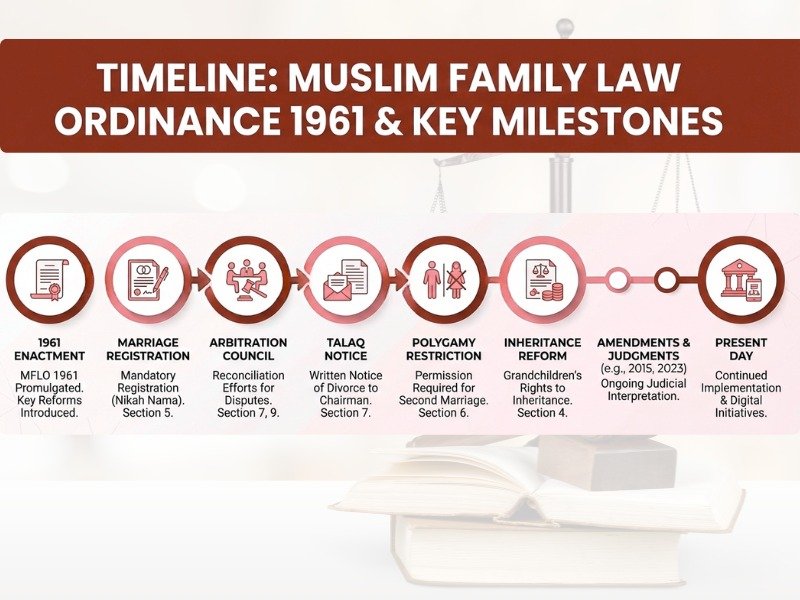
Every Muslim marriage (Nikah) must be registered with the Union Council of the area where the marriage takes place. The Union Council issues a Nikah Nama — the official marriage certificate. Failure to register does not invalidate the marriage but exposes the person responsible for registration to a fine of up to Rs. 1,000 and imprisonment of up to three months.
The Nikah Nama contains 30 clauses that determine the rights of both spouses, including the amount of Mehr (dower), any conditions attached to the marriage, and the wife’s delegated right of divorce. Completing the Nikah Nama carefully is one of the most important legal steps a Pakistani couple can take.
2. Polygamy Restrictions
Under Section 6 of MFLO, a husband who wishes to contract a second or subsequent marriage must obtain permission from the Union Council’s Arbitration Council. He must also have the existing wife’s written consent documented. Violation is punishable by imprisonment of up to one year and a fine of Rs. 5,000, as well as immediate payment of the entire Mehr of the existing wife.
Courts have consistently upheld these provisions. A second marriage contracted without compliance is not void, but the husband faces serious legal and financial consequences.
3. Divorce Regulation
MFLO Section 7 mandates that after pronouncing Talaq, the husband must give written notice to the Chairman of the Union Council and send a copy to the wife. Divorce does not take effect until 90 days after the Chairman receives the notice. During this period, the Arbitration Council attempts reconciliation. Only after 90 days, and failure of reconciliation, does the Talaq become final.
4. Maintenance of Divorced Wives
A divorced wife is entitled to maintenance during the Iddat period (90 days after divorce). MFLO also strengthened the enforcement of maintenance orders through the family courts.
5. Inheritance for Orphaned Grandchildren
One of MFLO’s most progressive reforms: if a child dies before their parent, the grandchildren from that child are entitled to inherit what their deceased parent would have received, up to the share they would have taken had the parent lived. This rule significantly protects grandchildren who would otherwise receive nothing.
| Have a question about MFLO and your marriage rights?Our family law team at Qadir Chamber has handled hundreds of MFLO-related matters across Pakistan. From Nikah Nama review to Arbitration Council proceedings, we protect your rights at every stage. Book your free consultation today → |
Marriage Laws in Pakistan: Legal Requirements and Your Rights
A legally valid Muslim marriage in Pakistan requires three essential elements: offer and acceptance (Ijab and Qabool, must be freely generated, not with coercion or fraud ), Mehr (dower), and witnesses, two adult, sane. ( Under the Shia law, the presence of witnesses doesn’t affect the legal status of marriage, but in Sunni law, their absence renders the marriage irregular) . Beyond these Islamic requirements, MFLO 1961 adds civil registration as a state obligation.
The Nikah Nama: Pakistan’s Marriage Contract
The Nikah Nama is not merely a certificate — it is a legally enforceable contract that defines the rights and obligations of both parties. Critically, Clause 18 of the standard Nikah Nama allows the wife to delegate to herself the right of divorce (Talaq-e-Tafweez). If checked and properly notarised, this clause gives the wife the same right to divorce as her husband.
Many Pakistani women are unaware that this clause exists or fail to have it properly included. Our family law team strongly recommends reviewing the Nikah Nama in detail before signing.
Minimum Age of Marriage
The Child Marriage Restraint Act 1929 (as amended) sets the minimum age of marriage at 18 years for boys and 16 years for girls. However, courts have increasingly protected girls from early marriage, and families can seek legal intervention against child marriages through the court system.
Marriage Registration: Step-by-Step
1. Nikah performed before a licensed Nikah Registrar or Qazi
2. Nikah Nama completed in triplicate, one copy each for husband, wife, and Union Council
3. Registration submitted to the Union Council within the prescribed period
4. CNIC details of both parties and witnesses recorded
5. Mehr amount specified (prompt and deferred portions separately)
6. Copy of Nikah Nama obtained by both parties, keep the original safe
Mehr (Dower): The Wife’s Financial Protection
Mehr is an obligatory payment from husband to wife, stipulated in the Nikah Nama. It has two components: Prompt Mehr (payable immediately on demand) and Deferred Mehr (payable on divorce or the death of the husband). Mehr is the wife’s exclusive property; it cannot be claimed by her family or offset against any other obligation.
Pakistani courts have consistently held that Mehr is a debt owed by the husband. It is recoverable through the family courts at any time. If you need help recovering unpaid Mehr, our women’s rights lawyers can assist.
Inter-Religious and Inter-Sect Marriages
Muslim-to-Muslim marriages across different sects (Sunni-Shia) are generally valid under Pakistani law, though certain procedural differences may apply. Marriages between a Muslim and a non-Muslim are a complex area governed by religious personal law. For specific guidance, consult our family law team.
Divorce Laws in Pakistan: Types, Procedures, and Legal Rights
Divorce is one of the most legally consequential steps a Pakistani family can face. Pakistani law recognises several types of divorce, each with different procedures, timelines, and financial implications. Understanding which type applies to your situation can mean the difference between a quick resolution and years of litigation.
Talaq: Husband-Initiated Divorce
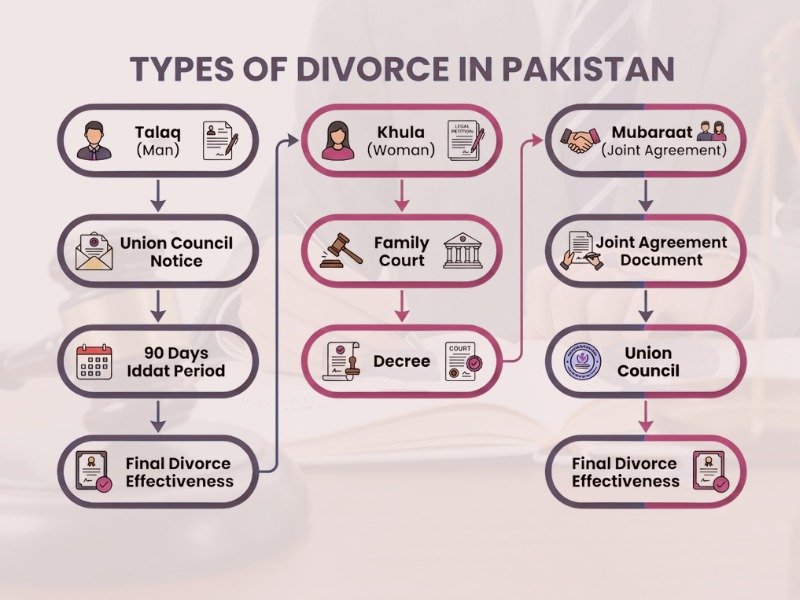
Talaq is the husband’s right to pronounce divorce unilaterally. Under MFLO Section 7, the husband must immediately give written notice to the Chairman of the Union Council in the area where the wife ordinarily resides. A copy must be sent to the wife.
The divorce does not take effect for 90 days. During this period, an Arbitration Council (comprising one representative each from the husband and wife, plus the Chairman) attempts reconciliation. If the wife is pregnant at the time of divorce, the waiting period extends until delivery.
Critically, oral Talaq pronounced three times in one sitting is not recognised by Pakistani courts as immediately effective. MFLO’s procedural requirements must be followed. Men who bypass the Union Council process remain legally married and face criminal sanctions.
Khula: Wife-Initiated Divorce
Khula is the wife’s right to seek dissolution of marriage, typically by returning all or part of the Mehr. Under the Dissolution of Muslim Marriages Act 1939 (as supplemented by MFLO), a wife may apply to the family court for Khula.
The court process for Khula in Pakistan has become significantly more streamlined. Under a landmark Supreme Court judgment, family courts can grant Khula even without the husband’s consent, though the wife may be required to return her Mehr. The case is usually resolved within 90 to 180 days, depending on the court’s workload.
Grounds available to a wife seeking divorce under the Dissolution of Muslim Marriages Act 1939 include:
• Husband’s whereabouts unknown for four years
• Husband’s failure to provide maintenance for two years
• Husband sentenced to seven or more years’ imprisonment
• Husband’s failure to perform marital obligations for three years
• Husband was impotent at the time of marriage
• Husband suffering from insanity, leprosy, or a virulent venereal disease
• Marriage contracted before age 16 and repudiated before age 18 ( provided that the wife had not conceived )
• Husband’s cruelty (physical, mental, or financial abuse)
For professional support in Khula proceedings, visit our Khula divorce lawyers service page.
Talaq-e-Tafweez: Delegated Divorce
This is a powerful provision often overlooked by Pakistani women. If the Nikah Nama includes a delegation clause (Clause 18), the wife may exercise her right to divorce herself without going to court. The same MFLO Section 7 notice requirements apply. This is the fastest form of divorce for women who have properly documented this right in their Nikah Nama.
Mutual Divorce (Mubaraat)
When both parties agree to end the marriage, they can file a joint divorce by mutual consent. This is the most straightforward process and avoids lengthy family court proceedings. Both parties sign a mutual divorce agreement, which is then processed through the Union Council under the standard 90-day MFLO procedure.
How Dower Works in Mutual Divorce :
In a mutual divorce, the handling of dower depends entirely on what the couple decides in their agreement:
Unless the wife explicitly waives (forgives) it in the divorce deed, the husband remains legally obligated to pay any outstanding dower.
Legal status:
Once the offer and acceptance are proceeded, it becomes a single irrevocable divorce. (Talaq -e -Bian).
Divorce and Financial Rights
Regardless of who initiates divorce, certain financial rights are automatic under Pakistani law:
• Wife is entitled to full prompt Mehr if not already paid
• Wife is entitled to deferred Mehr on divorce
• Maintenance (Nafqah) for the Iddat period, typically three months
• Return of all personal belongings, gifts, and dowry items
• Child maintenance if the wife retains physical custody.
For complex divorce cases involving property or overseas assets, see our divorce lawyers in Pakistan service.
| Going through a divorce? Whether you need Khula, are dealing with a disputed Talaq, or want to protect your financial rights during separation, Qadir Chamber’s family lawyers provide confidential, compassionate, and effective legal support in Lahore, Karachi, and Islamabad. |
Child Custody Laws in Pakistan After Divorce
Child custody is often the most emotionally charged aspect of family law in Pakistan. When parents separate, two separate legal concepts come into play: Hizanat (physical custody — who the child lives with) and legal guardianship (who makes decisions about the child’s life, education, and welfare).
Hizanat: The Mother’s Right to Physical Custody
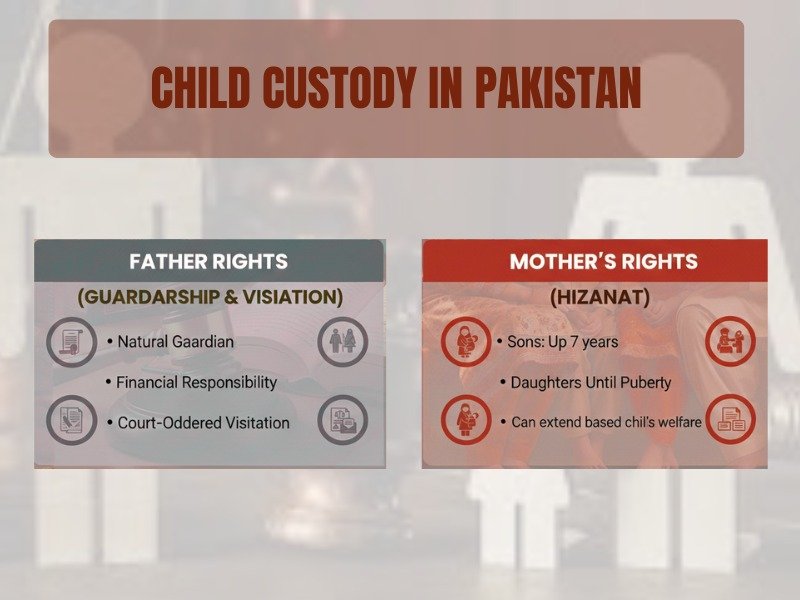
Under both Islamic jurisprudence and Pakistani law, the mother has the primary right to physical custody of young children after divorce, which is called Hizanat. The standard rules applied by Pakistani family courts are:
• Sons remain with mother until the age of 7 (Sunni law), Sons remain with mother until the age of 2 years, the end of the weaning period (Shia law).
• Daughters remain with their mother until puberty, typically age 14–16 ( Sunni law), and daughters remain with their mother until the age of 7 years ( Shia law)
• After these ages, custody may transfer to the father
• The father retains the right of guardianship throughout
However, these are default rules only. Courts can and do deviate from them based on the paramount consideration: the welfare and best interests of the child. If the mother remarries a man not related to the child (a non-Mahram), her right to Hizanat may be forfeited under traditional Islamic legal principles, though modern Pakistani courts weigh this against the child’s welfare.
Guardian and Ward Act 1890
The Guardian and Ward Act 1890 is the primary legislation governing guardianship in Pakistan. It applies to all citizens, regardless of religion. Under this Act, any person with an interest in the welfare of a minor can apply to the Family Court for appointment as guardian.
The court appoints a guardian based on several factors:
• Age and sex of the child
• Character and capacity of the proposed guardian
• Wishes of a deceased parent, if known
• Child’s own preference (if the child is old enough to form a view)
• The welfare principle: the child’s best interests override all other considerations
Legitimacy in Pakistani Family Law
A child born within a valid marriage, or within six months ( minimum) and up to 2 years ( maximum, provided that the woman remains unmarried during this period) after the dissolution of a valid marriage, is presumed legitimate under Pakistani law. Legitimacy determines inheritance rights, use of the father’s name, and entitlement to maintenance from the father. For complex cases involving legitimacy disputes, our family law specialists can advise.
Overseas Pakistanis and International Custody
Cross-border custody disputes, where one parent is in Pakistan and the other abroad, are increasingly common. Pakistan is not a signatory to the Hague Convention on International Child Abduction, which means enforcement of foreign custody orders in Pakistan can be challenging. If you are facing an international custody situation, contact our team immediately for specialist advice.
For dedicated custody legal support, visit our child custody lawyers page.
Guardianship Laws in Pakistan: Guardian and Ward Act 1890
Guardianship is distinct from custody. A guardian has legal authority over a minor’s person (physical care) or property (or both). Pakistan’s Guardian and Ward Act 1890 establishes the complete legal framework for guardianship proceedings.
Types of Guardians Under Pakistani Law
Natural Guardian: Under Islamic personal law, the father is the natural guardian of his minor children. In the father’s absence or incapacity, guardianship passes to the father’s father, then other male relatives in a prescribed order.
Testamentary Guardian: A guardian appointed by the will of the father. This is recognised under Pakistani law if the child is Muslim and the appointment is not contrary to the child’s welfare.
Court-Appointed Guardian: Where no natural or testamentary guardian exists, or where the natural guardian is unfit, the family court can appoint a suitable guardian under the Guardian and Ward Act.
De Facto Guardian: A person who acts as a guardian without formal legal authority. Courts can subsequently regularise such arrangements if they serve the child’s welfare.
Guardianship of a Minor’s Property
A guardian appointed over property must account for all dealings with the minor’s assets. The court supervises property guardians closely. Any sale, mortgage, or major decision regarding the minor’s property requires court approval. This protects minors from exploitation by unscrupulous relatives.
Removing or Changing a Guardian
A guardian can be removed by the court if found to be incompetent, to have abused the position, or if removal serves the minor’s welfare. Applications for variation of guardianship orders are heard by family courts. Our family law team represents clients in guardianship applications and disputes across Pakistan.
Inheritance and Property Rights Under Pakistani Family Law
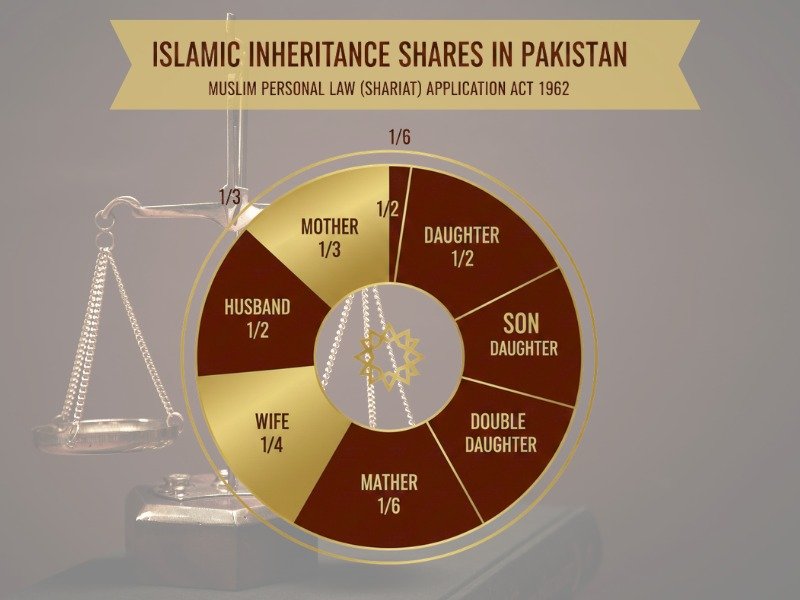
Inheritance law in Pakistan for Muslims is governed primarily by Islamic jurisprudence (Fiqh) as codified in the Muslim Personal Law (Shariat) Application Act 1962. This mandates that inheritance for Muslims is distributed according to Quranic injunctions (Faraid). The state enforces this system through civil courts.
Islamic Inheritance: Core Principles
Fixed Shares (Faraid): Certain relatives receive fixed shares regardless of the deceased’s wishes. These are called Quranic heirs. Key shares include:
| Heir | Share (No Son) | Share (With Son) |
| Husband | 1/2 of estate | 1/4 of estate |
| Wife (or wives) | 1/6 of the estate | 1/8 of estate |
| Daughter (1 only) | 1/2 of estate | Residue with son (2:1) |
| Mother | 1/3 of estate | 1/6 of estate |
| Father | 1/6 + residue | 1/2 of the estate |
Shares not taken by Quranic heirs are distributed to residuary heirs (Asaba), generally agnatic male relatives, in a prescribed order.
MFLO 1961 and Inheritance of Orphaned Grandchildren
As noted in Section 1, MFLO 1961 Section 4 creates an important exception to classical Islamic inheritance rules. Where a son or daughter predeceases their parent, the grandchildren from that child inherit the share the predeceased parent would have received. This protective provision has been widely litigated and consistently upheld by Pakistani courts.
Property Division After Divorce
Unlike many Western jurisdictions, Pakistan does not apply a default 50/50 marital property split on divorce. Each spouse retains their own property. The key financial rights on divorce are:
• Prompt and deferred Mehr: fully recoverable by wife
• Return of dowry (Jahez) items: recoverable by wife
• Maintenance during Iddat: three months
• Any jointly purchased property: resolved by the court based on contribution
• The wife’s own earnings and inheritances remain entirely hers
For detailed property division advice, visit our matrimonial property lawyers page.
Inheritance Disputes in Pakistan
Inheritance disputes are among the most common civil cases in Pakistani courts. Common causes include:
• Exclusion of daughters from agricultural land (illegal under current law)
• Fraudulent transfer of property by one heir before the estate is distributed
• Disputes over oral gifts (Hiba) made before death
• Challenges to wills that purport to deprive legal heirs of their fixed shares
• Non-registration of property in a deceased person’s name
Our inheritance dispute lawyers handle contested estate matters and ensure legal heirs receive their rightful shares.
Family Courts in Pakistan: How the System Works
Family law disputes in Pakistan are heard by dedicated Family Courts established under the Family Courts Act 1964. These courts have exclusive jurisdiction over:
• Dissolution of marriage (divorce)
• Dower and maintenance
• Restitution of conjugal rights
• Custody and guardianship of children
• Dowry and personal property recovery
• Paternity and legitimacy disputes
How to File a Family Law Case in Pakistan
7. Consult a qualified family lawyer to assess your case
8. File a written petition in the Family Court of the appropriate jurisdiction
9. Pay prescribed court fees
10. The court issues a summons to the respondent
11. Pre-trial proceedings, attempts at reconciliation or settlement
12. Evidence and hearing stage
13. Court judgment and decree
14. Enforcement of the decree if necessary
Average timeline: Family court cases in Pakistan range from six months (uncontested) to three to five years (heavily contested). Early legal advice significantly reduces delays. Contact our team at Qadir Chamber for any family law case assessment.
Alternative Dispute Resolution in Family Matters
Many family disputes, particularly maintenance and property matters, can be resolved through mediation or Arbitration Council proceedings mandated by MFLO. Our family law team actively pursues settlement when it protects our client’s interests, avoiding the cost and delay of full-court proceedings.
| External Reference Resources: For the official text of the Muslim Family Laws Ordinance 1961, see the Government of Pakistan’s Federal Legislation. For the international human rights context on Pakistani women’s legal rights, see UN Women Pakistan Resources. |
Women’s Rights Under Pakistani Family Law
Pakistani family law provides substantial rights to women, but awareness and enforcement remain challenges. Key protections include:
Legal Protections for Women in Family Matters
• Right to prompt and deferred Mehr, enforceable debt of husband
• Right to Khula, divorce at the wife’s initiative, streamlined by courts
• Right to Talaq-e-Tafweez if documented in Nikah Nama
• Right to maintenance during marriage and Iddat
• Right to Hizanat, physical custody of young children
• Equal inheritance rights under the Quranic Faraid shares
• Right to work and retain own earnings, husband has no claim on wife’s income
• Protection under
• Workplace protections under the Protection Against Harassment of Women at the Workplace Act 2010
Our women’s rights lawyers specialise in helping Pakistani women enforce these rights confidently and effectively. We also handle domestic abuse cases, workplace harassment, and women’s property rights.
Conclusion: Protecting Your Family’s Legal Rights
Family law in Pakistan is a rich, complex, and deeply consequential area of law. The Muslim Family Laws Ordinance 1961 transformed Pakistani family law by introducing transparency, accountability, and enforceable rights into what had previously been largely unregulated personal relationships. Combined with the Family Courts Act 1964, the Guardian and Ward Act 1890, and the evolving body of case law from Pakistan’s superior courts, the legal system provides robust, if not always easily accessible, protections for all family members.
The key message is this: your rights under Pakistani family law are meaningless unless you know them and enforce them. A Nikah Nama not carefully reviewed, a Mehr never recovered, a custody agreement never formalised, these translate directly into lost rights and financial harm.
Qadir Chamber’s family law team has spent over a decade helping Pakistani families navigate these exact challenges, across marriage, divorce, custody, guardianship, and inheritance. We provide clear advice, fast action, and genuine results.
FAQs
Q1. What is the Muslim Family Laws Ordinance 1961, and does it still apply today?
Yes, MFLO 1961 remains fully in force and is the primary legislation governing Muslim family matters in Pakistan. It has been amended and supplemented over the decades, but its core provisions, marriage registration, divorce procedure, polygamy restrictions, and grandchildren’s inheritance, continue to apply to all Muslim citizens of Pakistan.
Q2. Is an unregistered Nikah legally valid in Pakistan?
Yes, the marriage itself is valid if the Islamic requirements of offer, acceptance, Mehr, and witnesses are met. However, the failure to register makes it extremely difficult to enforce rights legally. Without a registered Nikah Nama, proving the marriage exists in court, claiming Mehr, filing for divorce, or establishing children’s legitimacy all become much harder. Always register your marriage.
Q3. How does family law apply to overseas Pakistanis?
Pakistani family law applies to Pakistani Muslim nationals regardless of where they reside. A divorce obtained abroad may not be recognised in Pakistan unless it follows or is substantially consistent with MFLO procedures. Overseas Pakistanis often face custody, inheritance, and property rights issues that require coordination between Pakistani and foreign legal systems.
Q4. Can a Pakistani wife divorce her husband without going to court?
Yes, if Clause 18 (Talaq-e-Tafweez) was checked in the Nikah Nama, the wife can exercise her right to divorce herself. She then follows the MFLO Section 7 procedure of notifying the Union Council. Otherwise, she must apply to the family court for Khula.
Q5. Are prenuptial agreements enforceable in Pakistan?
Pakistani law does not have a dedicated statute on prenuptial agreements. However, conditions attached to the Nikah Nama are enforceable as contractual terms. Specific conditions about property, maintenance, or the wife’s right to divorce can be included in the Nikah Nama and upheld by courts. Our prenuptial agreement lawyers advise on making these conditions legally effective.
Q6. What legal protection exists against domestic violence in Pakistan?
The Protection Against Harassment of Women at the Workplace Act 2010, the Punjab Protection of Women Against Violence Act 2016, and the Criminal Laws Amendment Acts provide comprehensive legal protection. Courts can issue protection orders, residence orders, and arrest orders.
Q7. What are a wife’s rights to maintenance after divorce?
A divorced wife is entitled to maintenance (Nafqah) during the Iddat period, typically three menstrual cycles or 90 days after divorce. The Iddat maintenance obligation is absolute regardless of the wife’s financial means. If the wife has custody of the children, the father is also responsible for child maintenance. Post-Iddat maintenance can be claimed in certain circumstances.