New Criminal Laws in Pakistan 2024-2025: Major Changes You Must Know
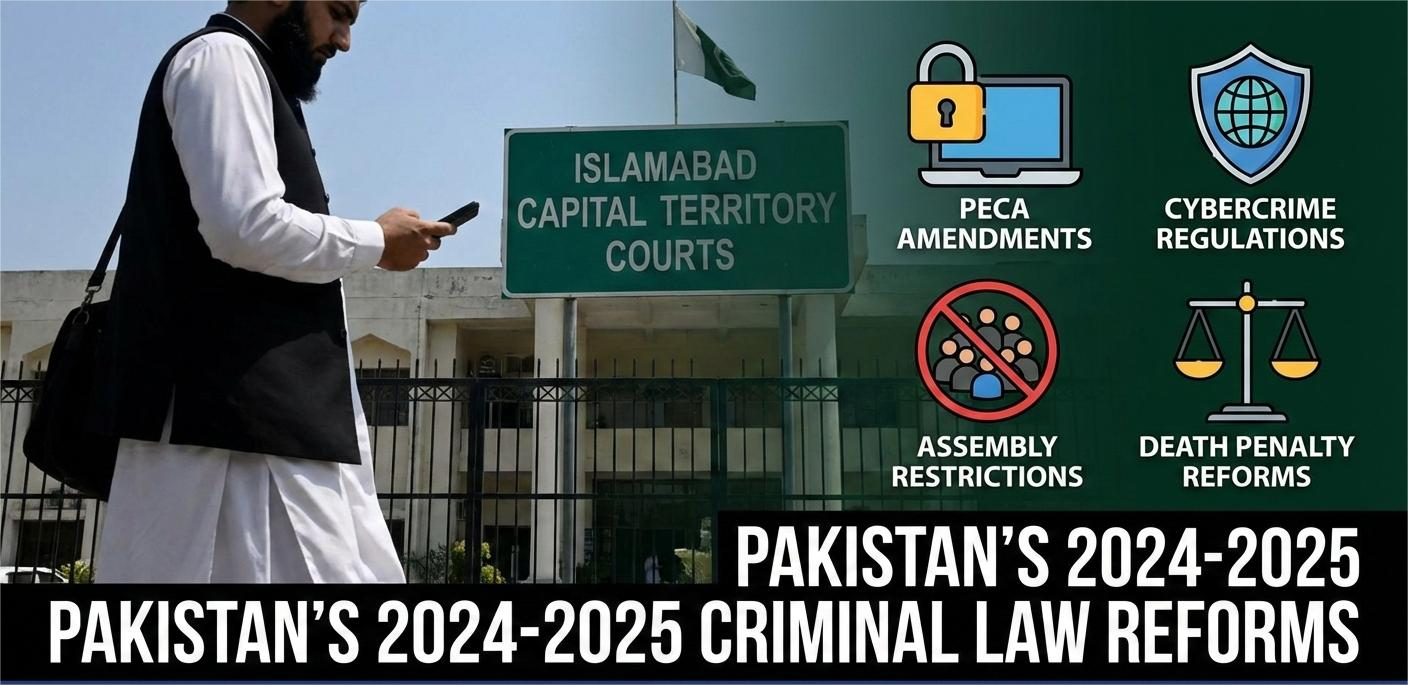
Pakistan introduces significant criminal law reforms in 2024-2025. Learn about PECA amendments, cybercrime regulations, assembly restrictions, and death penalty reforms that affect every citizen.
Pakistan’s legal landscape witnessed dramatic changes in 2024 and 2025. New criminal laws reshape how citizens interact online, assemble publicly, and face criminal charges. These amendments affect journalists, social media users, protesters, and everyday citizens.
This comprehensive guide explains the major changes in criminal law. You’ll discover what these new regulations mean for you and your rights.
Prevention of Electronic Crimes Act (PECA) Amendment 2025
The PECA Amendment 2025 represents Pakistan’s most controversial digital law reform. President Asif Ali Zardari signed it into law on January 29, 2025. This sweeping legislation fundamentally changes how Pakistanis interact online, communicate through social media, and express opinions digitally.
The law sparked immediate backlash from human rights organizations, journalists, and civil society. Parliament passed the bill in just four days with minimal debate. Opposition parties boycotted the session in protest.
What PECA 2025 Changed
The amendment introduces strict penalties for online content. It criminalizes spreading fake information. It establishes new regulatory bodies to monitor digital spaces.
This law replaces the previous PECA 2016 enforcement mechanisms. The government claims it combats misinformation and protects national security. Critics argue it enables censorship and stifles dissent. Key provisions include:
- Up to 3 years imprisonment for spreading false or fake information
- Fines up to Rs 2 million (approximately $7,000)
- Four new government bodies to regulate online content
- Expanded definition of unlawful online content
- 24-hour content removal mandate for social media platforms
New Digital Regulatory Bodies
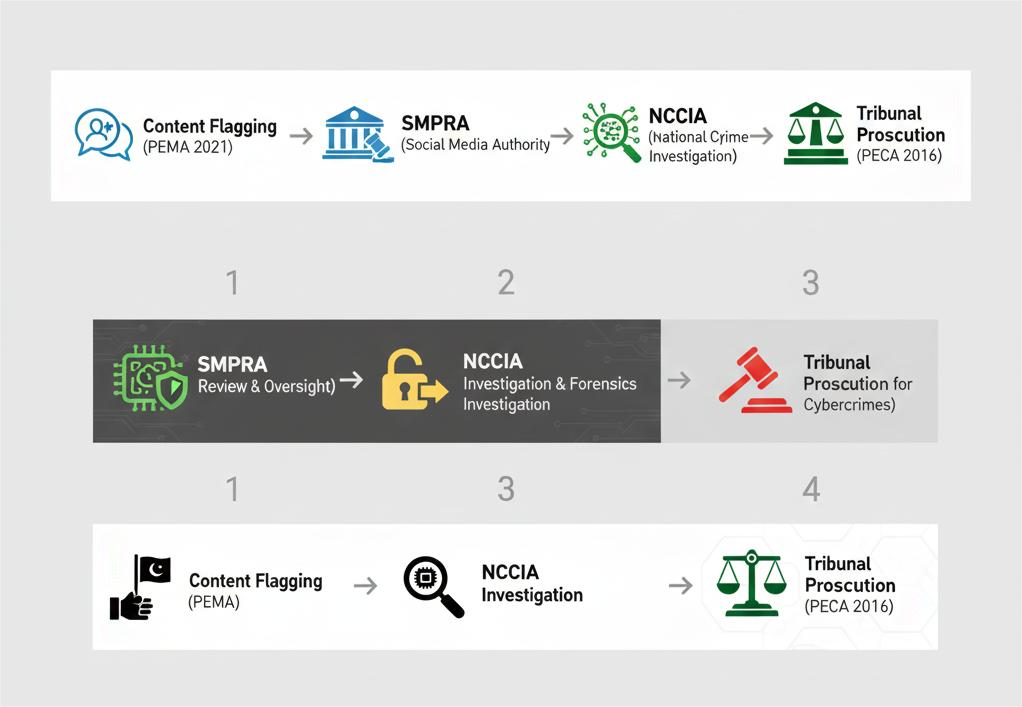
The law creates four enforcement agencies. All members are government-appointed. Critics warn about the lack of independent oversight. These bodies wield unprecedented power over digital content. They operate with minimal judicial oversight. International experts compare this structure to authoritarian internet controls.
- Social Media Protection and Regulatory Authority (SMPRA): Main regulatory body with content blocking powers
- Social Media Complaint Council: Handles user complaints and appeals
- Social Media Protection Tribunals: Government-appointed tribunals for prosecutions
- National Cyber Crime Investigation Agency (NCCIA): Exclusive investigation powers for cybercrime cases
Impact on Freedom of Expression
Human rights organizations condemn the amendments. Amnesty International calls the law draconian. Human Rights Watch demands immediate repeal. The United Nations Special Rapporteur on freedom of expression expressed serious concerns. Digital rights activists warn of a chilling effect on online speech. Self-censorship already increases among Pakistani internet users.
The law uses vague language. Terms like “false information” lack a clear definition. Authorities gain broad discretion to determine violations. This creates uncertainty for journalists and social media users. Over 200 journalists have faced PECA charges since 2017. The 2025 amendment further expands these restrictions.
Peaceful Assembly and Public Order Act 2024
President Zardari signed this law on September 6, 2024. It restricts public gatherings in Islamabad. The law was passed through parliament in just one week. This legislation targets political demonstrations in the capital. The timing coincided with planned protests by the opposition. Legal experts question its constitutional validity.
Key Restrictions on Protests
The Act imposes strict controls on peaceful assembly. Citizens must navigate complex permission requirements. Violations carry severe penalties. The restrictions apply exclusively to the Islamabad Capital Territory. Provincial assemblies consider similar legislation. The law creates a blueprint for nationwide protest restrictions.
- Seven-day advance notice required for all assemblies
- District Commissioner approval is mandatory before gathering
- Designated venues only (like Sangjani area)
- 3 years imprisonment for first-time unauthorized assembly
- 10 years imprisonment for subsequent violations
- Red zone restrictions in designated high-security areas
Police Enforcement Powers
Police gain extensive dispersal authority. They can use force without prior warning. Officers may arrest participants at their discretion. The law allows the immediate detention of protesters. No judicial approval needed for initial arrests. This raises concerns about arbitrary enforcement.
Civil liberties groups document increased police aggression since the law’s passage. Officers face no accountability for excessive force during dispersals. The law provides immunity for actions taken in “good faith.”
Criminal Laws Amendment Bill 2025: Death Penalty Reforms
The Senate approved major death penalty reforms in July 2025. This aligns Pakistan with international human rights standards. The reforms represent a positive shift in criminal justice policy.
Pakistan maintains one of the world’s broadest death penalty applications. Over 100 offenses still carry the death penalty. These reforms mark the first significant reduction in decades.
Death Penalty Abolition for Specific Crimes
The amendment removes capital punishment for certain offenses. It replaces death sentences with life imprisonment. This complies with EU trade agreement requirements.
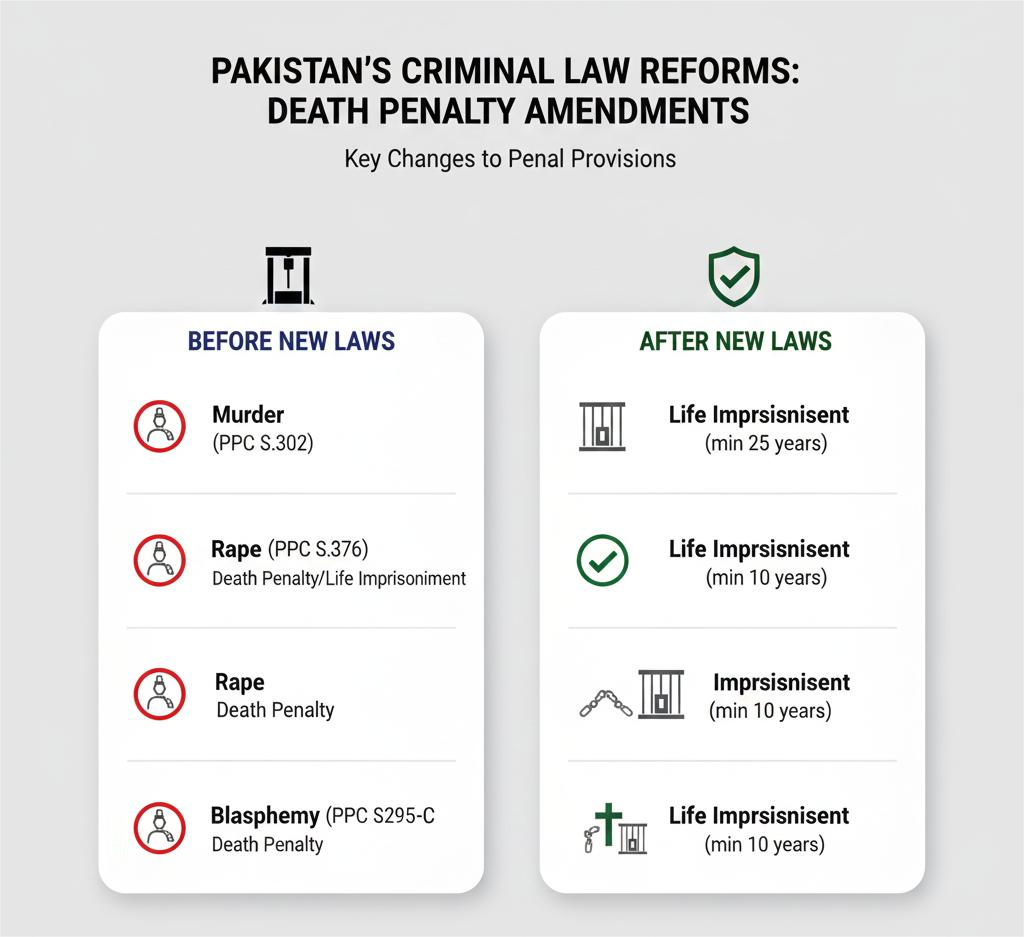
The reforms apply retroactively to prisoners on death row for these specific crimes. Legal experts estimate dozens of death sentences will be commuted. Courts must review and resentence affected individuals.
Affected Pakistan Penal Code sections:
- Section 354-A: Stripping women in public (now life imprisonment)
- Section 402-C: Harbouring hijackers (now life imprisonment)
GSP+ Trade Agreement Compliance
Pakistan benefits from EU trade preferences under GSP+. The agreement requires limiting capital punishment. The country must implement 27 international conventions. GSP+ status provides duty-free access to European markets for Pakistani exports.
This generates billions in annual revenue. Non-compliance risks suspension of these crucial trade benefits. Law Minister Azam Nazeer Tarar defended the reforms. He cited Europe’s lower crime rates despite the death penalty. Pakistan currently maintains capital punishment for over 100 offenses.
Additional Criminal Law Developments
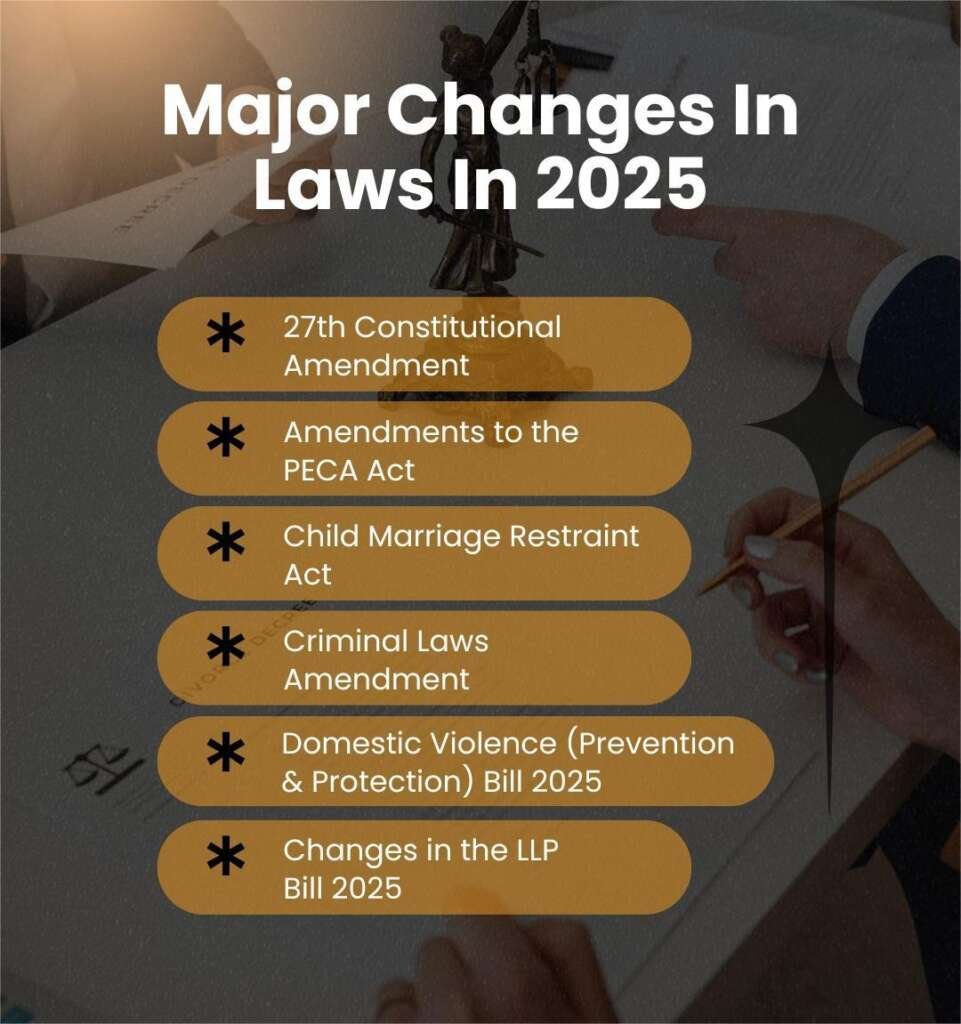
Proposed Black Magic and Witchcraft Bill
The Senate introduced this bill in September 2024. It targets practitioners of black magic and sorcery. The law aims to protect vulnerable citizens from fraud. Lawmakers cite numerous cases of exploitation through supernatural claims.
Fraudsters extract money from desperate families seeking cures or solutions. The bill criminalizes these deceptive practices while protecting legitimate religious counseling. Proposed penalties include:
- 6 months to 7 years imprisonment
- Fines up to Rs 1 million
- Non-bailable offense classification
- Exemption for licensed spiritual counselors from the Ministry of Religious Affairs
Comprehensive Comparison: New vs Old Laws
| Law Type | Previous Law | New Law 2024-2025 |
| Cybercrime (PECA) | Limited enforcement bodies, less defined penalties | 3 years prison + Rs 2M fine, 4 new regulatory bodies |
| Public Assembly | 6 months maximum imprisonment | 3-10 years imprisonment, 7-day advance notice |
| Death Penalty | Death penalty for 100+ offenses including Sections 354-A, 402-C | Life imprisonment replaces the death penalty for specific non-murder crimes |
How These Laws Affect You
These sweeping legal changes touch every aspect of Pakistani life. They reshape how citizens communicate, protest, and exercise fundamental rights. Understanding these impacts helps you navigate the new legal landscape safely.
For Social Media Users
Exercise extreme caution when sharing content. Verify information before posting. Avoid sharing unconfirmed news or rumors. Keep records of your sources. Social media became a legal minefield under these reforms.
Every post carries potential criminal liability. Even sharing others’ content can result in prosecution. The law’s vague definitions create risk. What authorities consider “false” remains unclear. Self-censorship increases among users.

For Journalists and Media Professionals
Journalists face heightened legal risks. The Pakistan Federal Union of Journalists challenges the law in court. Media organizations protest nationwide. Investigative journalism becomes increasingly dangerous under these regulations.
Sources fear retaliation under PECA provisions. Press freedom rankings for Pakistan continue declining. Seek legal advice before publishing sensitive stories. Document all sources thoroughly. Build transparent verification systems.
For Political Activists and Protesters
Submit assembly applications seven days in advance. Provide detailed venue and participant information. Prepare for possible denial or venue changes. Political organizing faces unprecedented obstacles.
Opposition parties struggle to mobilize supporters. The law effectively restricts democratic participation in the capital. Avoid unauthorized gatherings. Penalties now include years of imprisonment. Legal representation becomes essential.
International Human Rights Response
Global organizations condemn these legislative changes. Multiple watchdogs issue warnings about democratic backsliding. International pressure mounts on Pakistani authorities.
The European Union expresses concern about GSP+ compliance implications. United Nations human rights experts call for reviews. Foreign governments monitor the situation closely. Key Concerns from Rights Groups
- Amnesty International: Calls laws draconian, demands immediate withdrawal
- Human Rights Watch: Labels PECA amendment as a threat to internet freedom
- Reporters Without Borders: Ranks Pakistan low on 2024 press freedom index
- International Press Institute: Warns about new threats to journalism
Organizations urge Pakistan to align laws with international standards. They demand meaningful consultation with civil society. Calls for independent oversight intensify.
Ongoing Legal Challenges and Opposition
Multiple court challenges proceed against these laws. The Pakistan Federal Union of Journalists filed petitions in the Islamabad High Court. Other legal challenges emerge in provincial courts. Constitutional experts identify several grounds for challenging the laws.
These include violations of fundamental rights guaranteed in Articles 19 and 19-A. Civil society organizations coordinate legal strategies. Opposition parties walked out during legislative sessions. They tore up bill copies in protest. Critics argue that the rushed passage violated the proper legislative process.
Practical Steps to Protect Yourself
Knowledge provides your best defense under these restrictive laws. Concrete protective measures reduce your legal risk. Proactive preparation prevents many potential violations.
Digital Safety Measures
- Verify before sharing: Check multiple credible sources
- Document everything: Keep records of sources and fact-checking
- Understand your rights: Know appeal processes for content removal
- Avoid inflammatory language: Express opinions carefully
- Seek legal counsel: Consult lawyers for sensitive matters
Exercise Assembly Rights Safely
Peaceful protest remains a constitutional right despite new restrictions. Strategic planning helps navigate bureaucratic obstacles. Legal awareness protects your fundamental freedoms.
- Apply early: Submit requests seven days before planned assembly.
- Provide complete details: Include venue, timing, and participant numbers.
- Follow designated locations: Only assemble at approved venues.
- Prepare for appeals: Know the appeal process to the Chief Commissioner.
- Arrange legal support: Have lawyers on standby.
Expert Legal Assistance: How Qadir Chambers Can Help
Navigating Pakistan’s complex criminal laws requires experienced legal counsel. Qadir Chambers provides specialized expertise in criminal defense and digital rights. Their team understands the nuances of PECA 2025, assembly restrictions, and evolving criminal legislation.
The firm represents clients across Pakistan facing charges under new criminal statutes. They offer strategic defense for cybercrime allegations, protest-related charges, and criminal law matters. Qadir Chambers combines deep legal knowledge with practical courtroom experience.
Specialized Legal Services for Criminal Defense
Qadir Chambers offers comprehensive legal support tailored to Pakistan’s new criminal landscape. Their services address the specific challenges citizens face under recent legislation. The firm maintains a track record of successful defense in complex criminal matters. Key services include:
- PECA 2025 Defense: Expert representation for cybercrime allegations, false information charges, and social media prosecution cases
- Assembly Rights Protection: Legal assistance with protest permits, assembly applications, and defense against unauthorized gathering charges
- Constitutional Challenges: Filing petitions challenging unconstitutional provisions of new criminal laws
- Pre-Arrest Bail: Swift action to secure anticipatory bail before FIR registration or arrest
- Digital Rights Advocacy: Content removal appeals, account restoration, and SMPRA complaint proceedings
- Criminal Trial Defense: Complete representation from investigation through trial and appeals
- Legal Compliance Consulting: Preventive advice for journalists, activists, and social media users.
Why Choose Qadir Chambers for Criminal Matters
Qadir Chambers brings specific advantages to criminal defense under Pakistan’s new laws. Their attorneys stay current with rapidly evolving legislation and enforcement patterns. The firm maintains relationships with human rights organizations and international legal networks. Distinctive qualities include:
- Specialized Knowledge: Deep expertise in PECA, cybercrime law, and constitutional rights
- Proven Track Record: Successful defense in high-profile criminal and cybercrime cases
- Strategic Approach: Comprehensive defense strategies combining technical and legal arguments
- 24/7 Emergency Response: Rapid action for arrests, raids, and urgent legal situations
- Multi-City Presence: Services available across major Pakistani cities, including Islamabad, Lahore, and Karachi
- Confidential Consultations: Secure, discreet legal advice protecting client privacy
- Transparent Communication: Clear explanations of legal options, risks, and realistic outcomes.
When to Contact Qadir Chambers Immediately
Certain situations require immediate legal intervention. Time-sensitive criminal matters demand swift action. Qadir Chambers provides emergency legal response for urgent situations. Contact immediately if you experience:
- FIR Registration: Police file a First Information Report against you under PECA or other criminal provisions.
- Police Summons: You receive notice to appear for questioning about online posts or activities.
- Account Suspension: Social media platforms remove your content or suspend accounts due to government orders.
- Protest Arrest: Detention for participating in unauthorized assemblies or peaceful demonstrations.
- NCCIA Investigation: The National Cyber Crime Investigation Agency contacts you regarding online activity.
- Tribunal Prosecution: Social Media Protection Tribunals issue charges or summons.
- Search Warrant: Authorities plan to search your property or seize digital devices.
- Legal Threats: You receive warnings or threats of legal action for expressed opinions.
Preventive Legal Consultation Services
Prevention proves more effective than crisis management. Qadir Chambers offers proactive legal guidance for high-risk individuals. Journalists, activists, bloggers, and public figures benefit from preventive consultation.
The firm conducts a content review before publication. They assess legal risks in planned activities. Attorneys provide guidance on documentation and evidence preservation. This preventive approach minimizes exposure to criminal liability.
Regular legal audits help identify vulnerabilities. Qadir Chambers develops customized compliance protocols for organizations. Media houses, NGOs, and advocacy groups receive tailored protection strategies. These measures prevent violations before they occur.
Digital Evidence and Technical Defense
Cybercrime cases require technical expertise alongside legal knowledge. Qadir Chambers collaborates with digital forensics experts. They challenge questionable evidence and flawed technical claims. The firm understands IP tracking, metadata analysis, and digital authentication.
Attorneys examine the chain of custody for digital evidence. They identify procedural violations in device seizures and data extraction. Many PECA cases collapse due to technical deficiencies. Qadir Chambers exploits these weaknesses effectively.
The firm contests claims of account ownership and content authorship. They challenge timestamp accuracy and screenshot authenticity. Technical defense often provides the strongest protection in cybercrime prosecutions.
Qadir Chambers’ Approach to Criminal Defense
The firm employs a multi-layered defense strategy. Initial consultations assess case strength and identify vulnerabilities. Attorneys develop comprehensive legal strategies addressing all charges. They pursue multiple defensive tracks simultaneously.
Qadir Chambers challenges unconstitutional law applications. They file constitutional petitions in the High Courts. The firm seeks bail through anticipatory and post-arrest applications. Attorneys negotiate with prosecutors when beneficial.
Trial preparation includes witness examination and evidence challenges. The firm maintains aggressive cross-examination tactics. They present compelling arguments based on constitutional rights. Qadir Chambers fights for acquittals, not just reduced sentences.
How to Engage Qadir Chambers’ Legal Services
Initial consultations provide case evaluation and strategic recommendations. Contact the firm through its official channels. Emergencies receive priority response. The consultation process remains confidential and privileged.
Prepare relevant documents before the consultation. Gather FIRs, summons, notices, and correspondence. Collect screenshots, posts, and digital evidence. Document timelines and witness information. This preparation maximizes consultation effectiveness.
Qadir Chambers offers flexible fee arrangements for different client needs. They understand the financial constraints many defendants face. The firm provides transparent cost estimates upfront. Payment plans may be available for qualified clients.
IMPORTANT: Early legal intervention dramatically improves outcomes in criminal cases. Contact Qadir Chambers immediately upon facing any legal threat. Waiting reduces available options and weakens defensive positions. Professional legal representation protects your rights and freedom.
Conclusion: Navigating Pakistan’s New Legal Landscape
Pakistan’s criminal law reforms fundamentally alter citizen rights. The PECA Amendment 2025 restricts online expression. The Peaceful Assembly Act limits protest freedoms. Death penalty reforms show some human rights progress.
Citizens must understand these changes. Knowledge protects you from unintentional violations. Stay informed about enforcement patterns. Monitor legal challenges and their outcomes.
The international community watches closely. Pressure mounts for reforms that respect fundamental rights. Pakistan faces choices about its democratic future.
Exercise your rights responsibly. Document everything. Seek legal advice when needed. Stay connected with civil society organizations fighting for your freedoms.
FAQs
What is PECA 2025, and when did it become law?
The Prevention of Electronic Crimes (Amendment) Act 2025 became law on January 29, 2025, when President Asif Ali Zardari signed it. This amendment to Pakistan’s 2016 cybercrime law introduces strict penalties for disseminating false information online, establishes four new regulatory bodies, and expands government oversight of digital content. The law criminalizes “fake or false” information with a penalty of up to 3 years imprisonment and fines of up to Rs 2 million.
Can I be arrested for social media posts under the new cybercrime law?
Yes, you can face arrest and prosecution for social media content deemed false or harmful under PECA 2025. The National Cyber Crime Investigation Agency (NCCIA) has exclusive investigation powers. Authorities can charge you if the content is considered to cause “fear, panic, disorder, or unrest.” The law’s vague definitions mean even unintentional misinformation could lead to charges. Always verify information before sharing and maintain documentation of your sources.
What are the penalties for unauthorized protests in Islamabad?
Under the Peaceful Assembly and Public Order Act 2024, unauthorized assemblies in Islamabad carry severe penalties. First-time violations result in up to 3 years’ imprisonment. Subsequent offenses can lead to 10 years’ imprisonment. You must submit assembly applications seven days in advance to the District Commissioner. Even with permission, authorities can disperse gatherings at their discretion. The law applies only to the Islamabad Capital Territory but sets a precedent for provincial legislation.
How do the new laws affect journalists in Pakistan?
Journalists face increased legal risks under PECA 2025. Over 200 journalists have faced charges under PECA since 2017, and the 2025 amendment expands restrictions further. Media professionals risk 3-year prison terms for publishing content authorities deem false. The Pakistan Federal Union of Journalists challenges the law in court. Journalists should seek legal counsel before publishing sensitive stories, document all sources thoroughly, and understand appeal processes for content removal. International press freedom organizations rank Pakistan low on freedom indices.
What crimes no longer carry the death penalty in Pakistan?
The Criminal Laws Amendment Bill 2025 (approved July 2025) abolishes the death penalty for specific crimes. Section 354-A (stripping women in public) and Section 402-C (harboring hijackers) now carry life imprisonment instead of capital punishment. This reform aligns Pakistan with EU GSP+ trade agreement requirements under the International Covenant on Civil and Political Rights (ICCPR). However, Pakistan still maintains the death penalty for over 100 other offenses. The reforms represent partial compliance with international human rights standards.
What are the four new bodies regulating social media in Pakistan?
PECA 2025 creates four government-appointed enforcement agencies: (1) Social Media Protection and Regulatory Authority (SMPRA) – main regulatory body with content blocking powers; (2) Social Media Complaint Council – handles user complaints and appeals; (3) Social Media Protection Tribunals – government-appointed tribunals conducting prosecutions; (4) National Cyber Crime Investigation Agency (NCCIA) – exclusive cybercrime investigation authority. All members are appointed by the federal government without independent oversight, raising concerns about a lack of judicial independence.
How do I legally organize a protest in Islamabad?
Submit your application to the District Commissioner at least seven days before your planned assembly. Include detailed information: venue, number of participants, timing, and purpose. Applications must specify designated venues like Sangjani area. If denied, appeal to the Chief Commissioner, then to the Interior Secretary. District Magistrate evaluates security considerations and may alter permits. Assemblies outside designated areas are prohibited. Even approved gatherings can be dispersed by police at their discretion. Arrange legal representation in advance.
What is considered “false information” under PECA 2025?
PECA 2025 does not clearly define “false information,” which creates enforcement uncertainty. The law uses vague language describing information that could cause “fear, panic, disorder or unrest.” Authorities have broad discretion to determine violations. Content about state institutions, judiciary, armed forces, or parliament receives heightened scrutiny. Even unintentionally shared misinformation could result in charges. Human rights groups criticize this vagueness as enabling abuse. The ambiguous definitions threaten freedom of expression and encourage self-censorship.
Can I appeal if my social media content is removed?
Yes, PECA 2025 establishes the Social Media Complaint Council to handle appeals. If SMPRA removes your content or blocks your account, you can file a complaint with this council. However, council members are government-appointed without independent oversight. Critics warn the appeal process may favor state interests over citizen rights. Social media platforms must respond to removal orders within 24 hours or face penalties. Users should document all content and maintain evidence of their sources when filing appeals.
How do these laws compare to other countries’ digital regulations?
Analysts compare Pakistan’s PECA 2025 to strict internet controls in countries like China and Turkey. The law establishes government-controlled regulatory bodies similar to China’s cybersecurity framework. India’s Information Technology Act 2000 provides some parallels. However, Pakistan’s lack of independent oversight and vague definitions exceeds many international standards. Human rights organizations note the law contradicts Article 19 of the International Covenant on Civil and Political Rights, which Pakistan ratified. EU nations maintain stricter data protection with independent oversight, unlike Pakistan’s government-appointed tribunals.
How can Qadir Chambers help if I’m charged under PECA 2025?
Qadir Chambers provides specialized defense for PECA 2025 charges including false information allegations and cybercrime prosecutions. Their attorneys challenge technical evidence, file pre-arrest bail applications, contest unconstitutional provisions, and represent clients before Social Media Protection Tribunals and NCCIA investigations. The firm offers 24/7 emergency response for arrests and raids, handles content removal appeals through SMPRA, and develops comprehensive defense strategies combining legal arguments with technical forensics. They provide preventive consultation for journalists and activists to minimize legal exposure. Early engagement with Qadir Chambers significantly improves case outcomes through strategic bail applications, evidence challenges, and constitutional petitions in High Courts.