
Criminal Law in Pakistan: Complete Legal Guide 2026
Introduction
Understanding Criminal Law in Pakistan is essential for navigating legal challenges, protecting personal rights, and ensuring justice. Pakistan has a structured criminal justice framework based on codified laws and constitutional guarantees. This comprehensive 2026 guide covers key statutory provisions, trial procedures, bail rules, and rights of accused individuals. Whether facing legal proceedings or seeking legal awareness, this article outlines the core aspects of Pakistani criminal jurisprudence.
Foundations of the Criminal Justice System in Pakistan
The criminal justice system in Pakistan operates on statutory codifications originating from common law traditions, supplemented by Islamic jurisprudence provisions. The primary substantive statute is the Pakistan Penal Code 1860, which defines offences and prescribes punishments. Substantive law establishes what acts constitute crimes against individuals or the state.
Procedural aspects of criminal administration are regulated under the Code of Criminal Procedure 1898. The CrPC establishes rules for investigation, arrest, search, trial, and appeals. The Qanun-e-Shahadat Order 1984 dictates the rules of evidence applicable during criminal trials in Pakistani courts.
Major Criminal Offences under the Pakistan Penal Code
The Pakistan Penal Code categorizes criminal acts into distinct classes based on their nature and severity. Offences against the human body include hurt, assault, kidnapping, and culpable homicide. Qisas and Diyat provisions govern offences affecting human life and bodily integrity under Islamic criminal principles.
Offences against property constitute another major category under Pakistani law. These include theft, extortion, robbery, dacoity, and criminal breach of trust. Specialized statutes also regulate white-collar crimes, cybercrimes, anti-terrorism offences, and narcotics violations alongside the main penal code.
Criminal Investigation and Trial Procedure
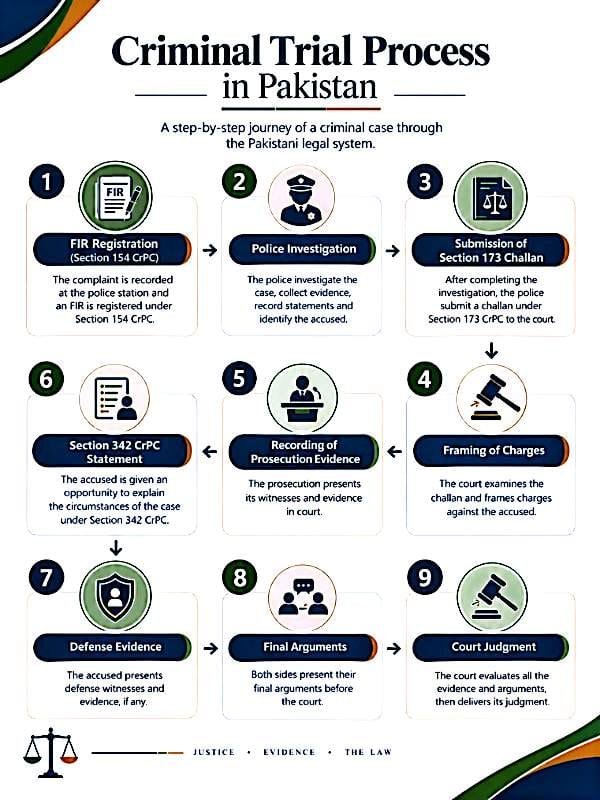
Criminal proceedings typically commence with the registration of a First Information Report under Section 154 of the CrPC for cognizable offences. Police officers conduct investigations, examine witnesses, gather physical evidence, and prepare a final report under Section 173 of the CrPC, commonly known as the challan.
Upon submission of the challan, the competent court takes cognizance and initiates trial proceedings. The court frames formal charges against the accused, records prosecution evidence, examines the accused under Section 342 CrPC, hears defense arguments, and delivers judgment based on proof beyond reasonable doubt.
Constitutional Rights of the Accused Person
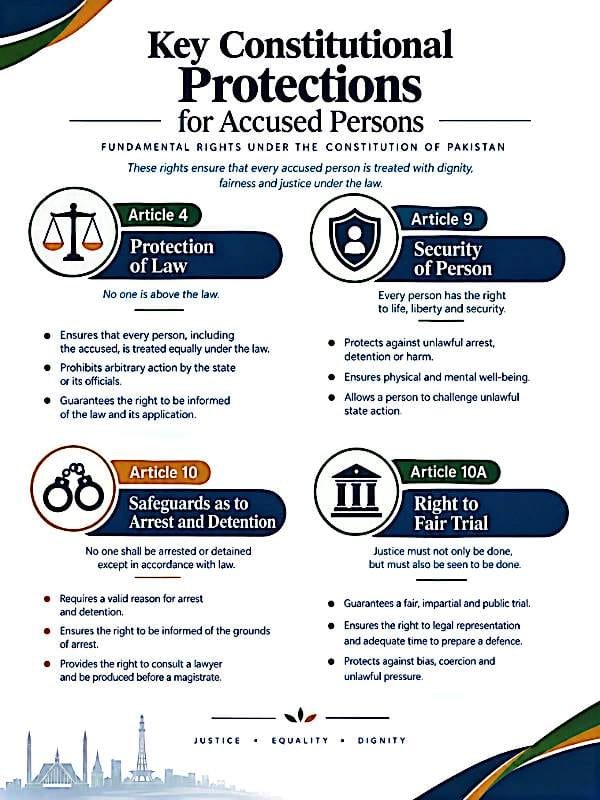
The Constitution of Pakistan guarantees fundamental protections to every person facing criminal allegations. Article 4 ensures the right to be dealt with in accordance with law. Article 9 protects the fundamental right to life and liberty, preventing unlawful state restraint.
Article 10 provides explicit safeguards against arbitrary arrest and detention, guaranteeing the right to consult and be defended by a legal practitioner of choice. Furthermore, Article 10A secures the right to a fair trial and due process in the determination of any criminal charge.
Bail Provisions in Pakistani Criminal Law
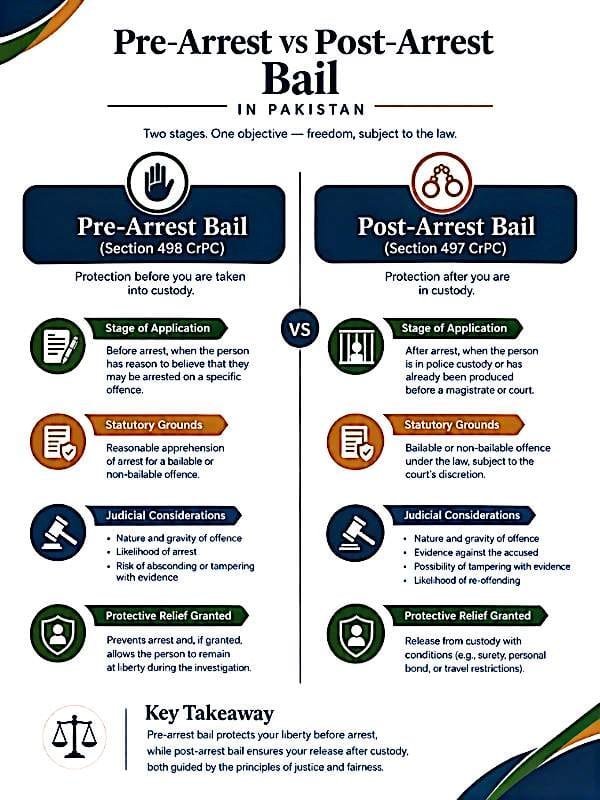
Bail serves as a mechanism to release an accused person from custody pending investigation or trial. Pre-arrest bail, granted under Section 498 CrPC, protects individuals from arrest intended for harassment or ulterior motives. Post-arrest bail under Section 497 CrPC applies after an individual has been taken into custody.
Bail in bailable offences is a matter of right for the accused individual. In non-bailable offences, bail remains a judicial discretion dependent on the severity of the offence, availability of evidence, and circumstances of the case.
Cognizable vs Non-Cognizable Offences Comparison
| Parameter | Cognizable Offence | Non-Cognizable Offence |
|---|---|---|
| Police Arrest Power | Arrest without warrant permitted | Arrest requires a judicial warrant |
| Investigation Initiation | Police investigate without court order | Requires permission from Magistrate |
| FIR Registration | Registered under Section 154 CrPC | Recorded under Section 155 CrPC |
| Examples | Murder, Theft, Robbery | Simple Hurt, Defamation |
Role of a Criminal Lawyer in Pakistan
Securing experienced legal counsel is crucial when navigating criminal allegations or pursuing prosecution. A competent legal practitioner evaluates case facts, drafts bail applications, cross-examines witnesses, and protects constitutional guarantees throughout judicial proceedings. Timely legal intervention often prevents procedural irregularities and safeguards individual liberty.
Individuals seeking professional guidance can consult qualified advocates through Qadir Chambers. Expert representation ensures effective defense preparation and adherence to statutory procedural rules in Pakistani trial courts.
Navigating Relocation in Dubai: Legal Frameworks, Consumer Rights, and Choosing the Right Movers in Business Bay
Relocating a home or office in Dubai’s bustling commercial hub Business Bay involves complex logistical planning and strict adherence to local regulations. Whether you are transferring a corporate headquarters along Marasi Drive or moving into a high-rise residential apartment near Dubai Canal, understanding your legal protections, tenancy obligations, and service contracts is essential for a seamless transition.
This guide outlines the critical legal frameworks governing relocations in Dubai, key judicial standards regarding service contracts and liabilities, and practical steps for selecting reliable Movers in Business Bay.
1. The Legal Framework Governing Relocations in Dubai
When hiring moving services or vacating a property in Dubai, several regulatory frameworks govern the relationships between tenants, property owners, and service providers.
A. Civil Transactions Law (UAE Federal Law No. 5 of 1985)
Contracts signed with moving and packing companies fall under the rules of service contracts (Contract for Work or Muqawala) under the UAE Civil Transactions Law:
- Duty of Care (Article 877): The service provider is legally obligated to execute the work according to the contract terms and with reasonable care.
- Liability for Damage (Article 878): If a mover damages goods during packing, transit, or handling, they are contractually liable to repair or compensate for the loss, provided the damage was caused by negligence or failure to adhere to agreed standards.
B. Consumer Protection (UAE Federal Law No. 15 of 2020)
The UAE Consumer Protection Law safeguards consumers against sub-standard services and unfair practices:
- Right to Clear Information (Article 4): Movers must provide transparent, written estimates without hidden charges.
- Service Guarantees (Article 12): Consumers have the right to receive services that match the specifications agreed upon. If a moving company fails to deliver within the agreed timeframe or causes property loss, the consumer has the right to log a dispute with the Dubai Department of Economy and Tourism (DET) via the Consumer Rights portal.
C. Tenancy and Property Access Laws (RERA & Decree No. 43 of 2013)
Vacating or moving into a property in Business Bay requires compliance with Real Estate Regulatory Agency (RERA) rules and master community management guidelines:
- Move-In / Move-Out Permits: Most high-rise towers in Business Bay (managed by developers like DAMAC, Dubai Properties, or Emaar) legally require approved Move-In/Move-Out permits. Moving without these permits can result in security denying building access to your moving truck.
- Security Deposit Refund Obligations: Under Dubai Law No. 26 of 2007 (regulating the landlord-tenant relationship), landlords are obligated to refund the security deposit (or the remaining balance) upon contract termination, minus fair wear and tear. Having professional movers restore the property to its original condition helps avoid judicial disputes before the Rental Dispute Centre (RDC).
2. Judicial and Arbitral Precedents on Goods in Transit & Liability
In commercial disputes and rulings handled by Dubai Courts and the RDC, several principles regularly shape outcomes regarding moving and logistics disputes:
- Proof of Condition (Inventory Lists): Judicial committees consistently place heavy weight on signed Inventory Condition Reports. If a customer signs an inventory sheet acknowledging receipt of goods in good condition upon delivery, the burden of proof shifts heavily onto the customer to prove that damage occurred during transit rather than post-delivery.
- Exclusion Clauses: Under UAE law, contractual clauses attempting to completely exempt a service provider from liability for gross negligence or intentional fault (dolus) are generally held void by UAE courts under Article 390 of the Civil Code, which allows judges to adjust agreed compensation to reflect actual damage suffered.
- Third-Party Building Damage: If unaccredited movers cause structural or common-area damage (e.g., damaging elevator cladding or hallway walls), building management holds the tenant directly liable under community rules. The tenant must then seek recourse against the contractor through civil litigation or DET arbitration.
Key Takeaways
- Criminal Law in Pakistan is primarily codified in the Pakistan Penal Code 1860 and Code of Criminal Procedure 1898.
- Cognizable offences allow police arrest without warrant, whereas non-cognizable offences require judicial authorization.
- The Constitution of Pakistan guarantees fundamental rights to accused persons, including fair trial protections under Article 10A.
- Pre-arrest bail prevents malicious arrests, while post-arrest bail addresses pre-trial detention release.
- Professional legal representation ensures protection of procedural rights and effective trial defense.
Frequently Asked Questions (FAQs)
1. What is an FIR in Pakistani criminal law?
A First Information Report (FIR) is a document prepared by police under Section 154 CrPC after receiving information about the commission of a cognizable offence.
2. Can police arrest a person without a warrant in Pakistan?
Yes, police officers can arrest an accused person without a warrant in cognizable offences as authorized under the Code of Criminal Procedure 1898.
3. What is the difference between bailable and non-bailable offences?
In bailable offences, bail is a statutory right of the accused person. In non-bailable offences, granting bail is subject to judicial discretion based on case circumstances.
4. What protection does Article 10A of the Constitution provide?
Article 10A of the Constitution of Pakistan guarantees the fundamental right to due process and a fair trial in all criminal and civil proceedings.
5. What is a Section 173 CrPC report or challan?
A challan is the final investigation report prepared by police under Section 173 CrPC detailing gathered evidence, witness statements, and formal charges against the accused.
6. How does pre-arrest bail work in Pakistan?
Pre-arrest bail under Section 498 CrPC is granted by high courts or sessions courts to prevent arrest when there is reasonable apprehension of arrest due to malicious prosecution.
7. Why is hiring a criminal defense lawyer necessary?
A specialized defense lawyer protects constitutional rights, examines evidence, files bail applications, and represents the accused during trial proceedings to ensure a fair trial.