Copyright Law in Pakistan – Rights & Protection Guide
Introduction
Understanding Copyright Law in Pakistan is essential for every creator and business owner operating in the modern digital economy. This framework establishes the legal foundation for protecting original intellectual creations from unauthorized exploitation. At Qadir Chambers, our Intellectual Property Lawyers in Pakistan provide specialized Legal Consultation to safeguard your creative assets. This guide explores the statutory provisions and enforcement mechanisms available under local legislation.
What Is Copyright Law in Pakistan?
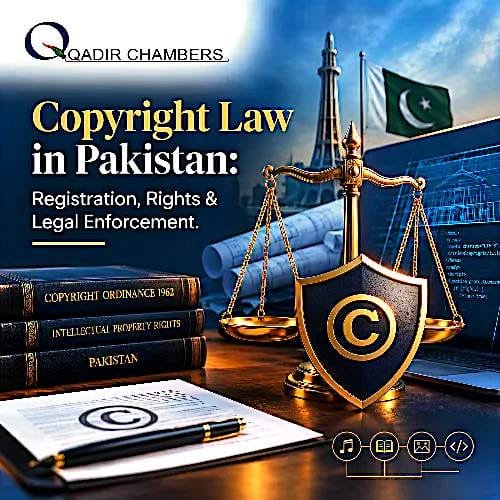
Copyright Law in Pakistan is an essential component of intellectual property rights that grants creators exclusive control over their original works. The principal legislation governing this domain is the Copyright Ordinance 1962. This statute has been amended over the years to keep pace with technological advancements and international obligations under the Berne Convention and the TRIPS Agreement.
The primary purpose of this law is to encourage creativity by ensuring that authors and creators can reap the economic benefits of their labor. It balances the rights of the creator with the public interest in accessing knowledge and information. Under Section 3 of the Copyright Ordinance 1962, copyright is defined as the exclusive right to do or authorize the doing of various acts in respect of a work or any substantial part thereof.
The Law Firm in Pakistan landscape recognizes that copyright protects the expression of an idea rather than the idea itself. This means that while two people can have the same idea for a story, the specific way they write it is what receives legal protection. For businesses, this law is critical for protecting branding materials, software code, and marketing content.
What Works Are Protected by Copyright?
Section 10 of the Copyright Ordinance 1962 specifies the categories of works in which copyright subsists. For a work to be protected, it must be original and expressed in a tangible form. The following categories are explicitly covered:
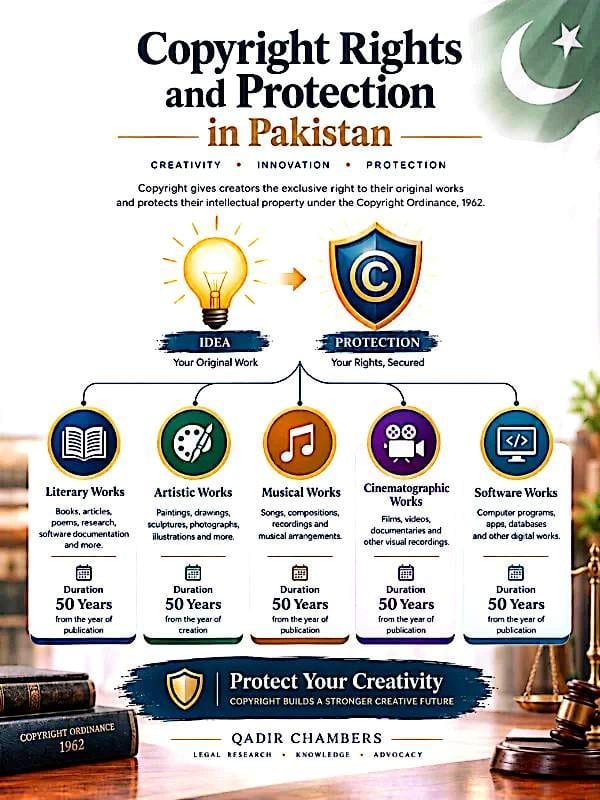
Literary Works
This includes books, magazines, news articles, letters, and computer programs. Even a compilation of data or a database can be protected if there is sufficient creativity in the selection and arrangement of the content.
Dramatic and Musical Works
Dramatic works include plays, scripts, and choreographic works. Musical works encompass the musical composition itself, including any accompanying lyrics.
Artistic Works
This broad category covers paintings, sculptures, drawings, engravings, photographs, and works of architecture. Our Intellectual Property Lawyers in Pakistan often assist graphic designers and architects in asserting their rights over these creations.
Cinematographic Works and Sound Recordings
Protection extends to films, documentaries, and any sequence of moving images, as well as the audio recordings of songs or speeches.
Copyright Ownership and Author rights
Determining the first owner of a copyright is a critical step in any legal dispute. Under Section 13 of the Copyright Ordinance 1962, the author of the work is generally the first owner of the copyright. However, there are significant exceptions:
- Work for Hire: If a work is created during the course of employment, the employer is usually the first owner of the copyright, unless there is a contract to the contrary.
- Commissioned Works: For certain works like portraits or photographs made for valuable consideration, the person who commissioned the work may be the owner.
- Government Works: The government owns the copyright in works produced by or under the direction of government departments.
Section 14 allows for the assignment of copyright. This must be done in writing and signed by the assignor to be legally valid. At Qadir Chambers, we assist clients in drafting assignment agreements through our Corporate Law and Commercial Law services to ensure clear transfer of rights.
Authors also possess moral rights. Even if they sell the economic rights, they retain the right to be identified as the author and the right to object to any distortion or mutilation of the work that would be prejudicial to their honor or reputation.
Copyright Registration and Protection
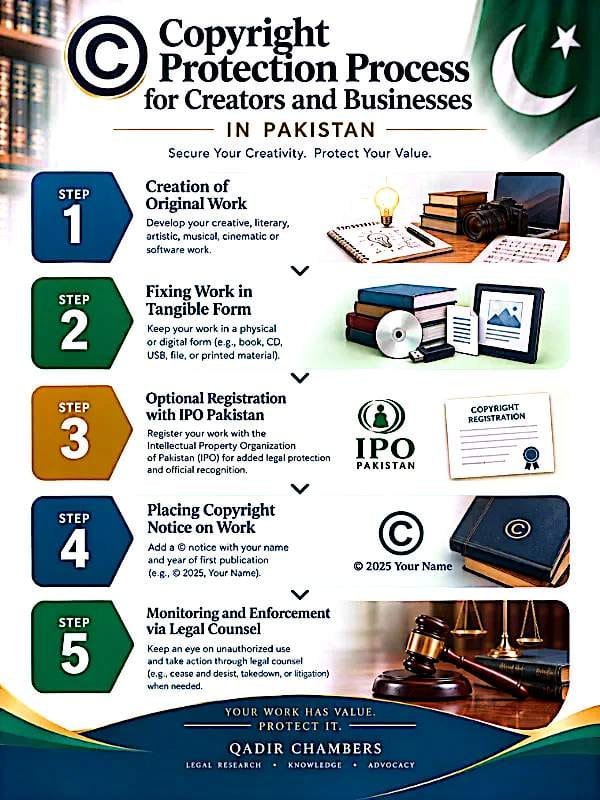
In Pakistan, copyright protection is automatic from the moment a work is fixed in a tangible medium. There is no mandatory requirement for registration to enjoy protection. However, registration with the Intellectual Property Organisation (IPO) of Pakistan is highly recommended for several reasons.
Registration serves as prima facie evidence in a court of law. According to the Pakistan Code, a certificate of registration issued by the Registrar of Copyrights is accepted as evidence that the person named is the actual owner. This significantly simplifies the burden of proof in Civil Litigation cases.
The duration of protection varies by category:
- Literary, dramatic, musical, and artistic works are protected for the life of the author plus 50 years after their death.
- Cinematographic works and sound recordings are protected for 50 years from the beginning of the calendar year next following the year in which the work was published.
What Counts as Copyright Infringement?
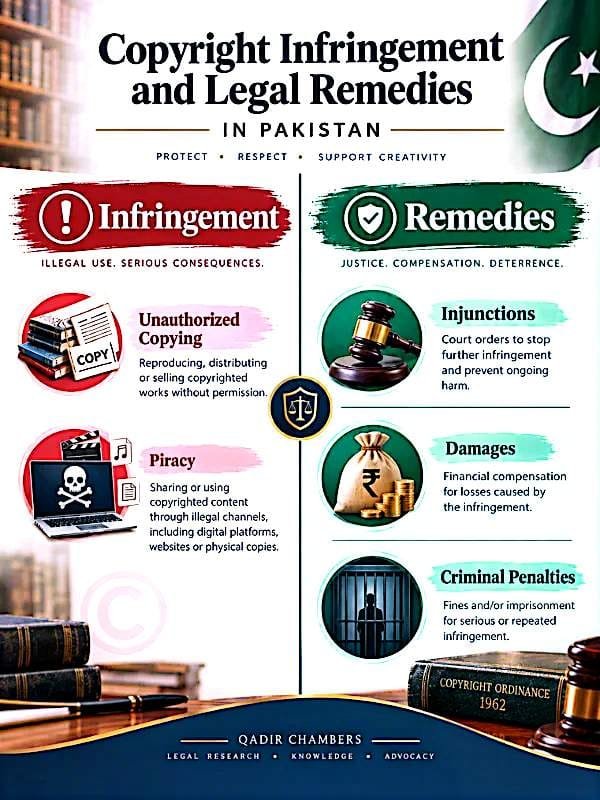
Copyright infringement occurs when someone exercises the exclusive rights of the copyright owner without obtaining prior permission or a license. Section 56 of the Copyright Ordinance 1962 provides a detailed definition of what constitutes an infringement.
Common examples of infringement include:
- Making unauthorized copies of a book or software for sale.
- Publicly performing a musical work without a license.
- Distributing protected content over the internet without authorization.
- Importing infringing copies into Pakistan for the purpose of sale or hire.
The law does provide for certain exceptions under the concept of Fair Use or Fair Dealing. For instance, using a small portion of a work for criticism, review, news reporting, or private study may not be considered infringement. However, the boundaries of fair use are often narrow and require careful legal analysis.
Civil and Criminal Remedies
The legal framework in Pakistan provides robust remedies for copyright owners whose rights have been violated. These are categorized into civil and criminal actions.
Civil Remedies
Under Section 60, a copyright owner can file a suit in a District Court to seek:
- Injunctions: A court order to stop the infringing activity immediately.
- Damages: Monetary compensation for the loss suffered by the owner.
- Accounts of Profits: Forcing the infringer to hand over the profits made from the illegal use of the work.
- Delivery Up: Ordering the destruction or delivery of all infringing copies and the plates used for making them.
Criminal Remedies
Copyright infringement is also a criminal offense in Pakistan. Under Section 66, any person who knowingly infringes or abets the infringement of copyright can be punished with:
- Imprisonment which may extend to 3 years.
- A fine which may extend to 100,000 Rupees.
The police have the power to seize infringing copies and equipment used for making them without a warrant, provided they have reasonable grounds to believe an offense is being committed. For assistance with such matters, you may require Criminal Law expertise alongside intellectual property knowledge.
Role of Pakistani Courts and Judicial Decisions
The judiciary plays a pivotal role in interpreting and enforcing copyright laws. The High Courts and the Supreme Court of Pakistan have established precedents that clarify the application of the Copyright Ordinance 1962.
Courts often rely on the Qanun-e-Shahadat Order 1984 to determine the admissibility of evidence, especially in cases involving digital piracy and electronic records. In recent years, Pakistani courts have become increasingly proactive in protecting the rights of software developers and media houses, recognizing the economic value of these industries.
When a dispute arises, the court examines whether the work in question is truly original and whether the defendant has copied a substantial part of that work. Judicial decisions have consistently held that even if the entire work is not copied, taking the heart of the creative expression constitutes a violation of the law.
How Businesses and Creators Can Protect Their Work
Proactive protection is always more effective than reactive litigation. Creators and businesses should follow a structured approach to safeguard their intellectual property:
- Register Your Work: While not mandatory, obtaining a certificate from IPO Pakistan provides a solid legal foundation for enforcement.
- Use Copyright Notices: Place the symbol © along with the name of the owner and the year of first publication on all works. This puts the public on notice.
- Implement Robust Contracts: Use non disclosure agreements and clear employment contracts that specify ownership of intellectual property created during the term of service.
- Monitor the Market: Regularly check for unauthorized use of your content online or in physical markets.
- Seek Professional Advice: Engage Legal Services in Pakistan early to audit your intellectual property portfolio.
Key Takeaways
- Copyright Law in Pakistan is governed by the Copyright Ordinance 1962.
- Protection is automatic upon creation but registration offers significant evidentiary advantages.
- The author is generally the first owner unless the work was created during employment.
- Protection typically lasts for the life of the author plus 50 years.
- Infringement can lead to both civil lawsuits and criminal prosecution.
- Both economic and moral rights are protected under the law.
Detailed Comparison of Copyright Categories
| Copyright Category | Eligible Works | Duration of Protection | Primary Rights Granted | Key Infringement Remedies |
|---|---|---|---|---|
| Literary Works | Books, scripts, software, databases | Life of author plus 50 years | Reproduction, translation, adaptation | Injunctions, damages, jail time |
| Artistic Works | Paintings, photos, architecture | Life of author plus 50 years | Reproduction, public display | Seizure of infringing copies |
| Musical Works | Compositions, lyrics | Life of author plus 50 years | Performance, recording rights | Fines, accounts of profits |
| Cinematograph | Films, documentaries | 50 years from publication | Public screening, distribution | Criminal prosecution, destruction |
| Sound Records | Audio recordings, podcasts | 50 years from publication | Duplication, broadcasting | Civil damages, police seizure |
FAQs
1. Is copyright registration mandatory in Pakistan?
No, copyright registration is not mandatory. Protection begins as soon as the work is created. However, registration is highly recommended because it serves as official evidence of ownership in court.
2. How long does copyright protection last for a book?
For a literary work like a book, the copyright lasts for the lifetime of the author and continues for an additional 50 years after their death.
3. Can I copyright a business idea?
No, copyright does not protect ideas, methods, or concepts. It only protects the specific expression of those ideas, such as a written business plan or a recorded presentation.
4. What is the penalty for copyright infringement in Pakistan?
Criminal penalties include up to 3 years of imprisonment and fines up to 100,000 Rupees. Civil remedies include injunctions and monetary damages.
5. Does a work created by an employee belong to the company?
Generally, yes. Under Section 13, if a work is created in the course of employment under a contract of service, the employer is the first owner of the copyright unless a different agreement exists.
6. Can I use a small part of someone else’s work without permission?
You may be able to use a small portion under the Fair Dealing provisions for purposes like criticism, news reporting, or private study. However, this is subject to strict legal interpretation.
7. How do I register my copyright with IPO Pakistan?
You must submit an application form to the Copyright Office along with the prescribed fee and copies of the work. The Registrar will then examine the application before issuing a certificate.