Civil Law vs Criminal Law – Key Differences Explained
The legal system of Pakistan operates on a dualistic framework that separates private disputes from public offenses. Navigating the complexities of these legal avenues requires the expertise of a Trusted Law Firm in Pakistan. While both systems seek justice, their procedures, objectives, and consequences vary significantly. Understanding the nuances between Civil Law and Criminal Law is essential for anyone seeking legal recourse. This guide explores how these systems function under Pakistani statutes like the CPC and PPC.
Defining the Legal Framework in Pakistan
The foundations of the Pakistani legal system are rooted in English Common Law, adapted through various statutes to meet local socio-political requirements. At its core, the law is divided into two primary categories: civil and criminal. This distinction ensures that the state can maintain order while allowing individuals to resolve private grievances through structured Legal Services in Pakistan.
Criminal law deals with conduct that is considered an offense against the state or society as a whole. Conversely, civil law addresses disputes between individuals or organizations, typically involving disagreements over contracts, property, or family matters. Choosing the right path starts with a professional Legal Consultation to determine the nature of the grievance.
What is Criminal Law?
Criminal law is the body of law that defines criminal offenses and regulates the apprehension, charging, and trial of suspected persons. In Pakistan, the substantive part of criminal law is contained in the Pakistan Penal Code (PPC) 1860, which lists various offenses and their respective punishments.
The procedural aspect is governed by the Code of Criminal Procedure (CrPC) 1898. This statute outlines how investigations are conducted, how arrests are made, and how trials proceed in the Magistrate or Sessions Courts. When a crime is committed, it is viewed as a “wrong against the public,” and the state acts as the prosecutor.
Primary Characteristics of Criminal Law
- Public Wrong: Crimes are considered offenses against the peace and stability of the entire community.
- The State as Prosecutor: The government, through the police and public prosecutors, brings the case against the accused.
- Punitive Focus: The primary goal is to punish the offender and deter others from committing similar acts.
- Serious Consequences: Penalties include imprisonment, heavy fines, or in extreme cases, the death penalty.
What is Civil Law?
Civil law governs private disputes between two or more parties. Unlike criminal proceedings, civil cases do not aim to punish an individual for a crime but rather to provide a remedy for a wrong suffered by the plaintiff. Most civil matters in Pakistan are governed by the Code of Civil Procedure (CPC) 1908, which provides the mechanism for Civil Litigation.
Typical civil cases include property disputes, breach of contract, divorce proceedings, and torts such as negligence or defamation. The person who initiates the lawsuit is known as the “Plaintiff,” and the person being sued is the “Defendant.”
Primary Characteristics of Civil Law
- Private Dispute: The legal action concerns the rights and obligations of individuals or entities toward each other.
- Remedial Focus: The goal is to return the injured party to the position they were in before the dispute occurred.
- Compensation: Remedies usually involve monetary damages, specific performance of a contract, or permanent injunctions.
- Initiated by Individuals: The state does not initiate civil suits; it only provides the forum (the courts) to resolve them.
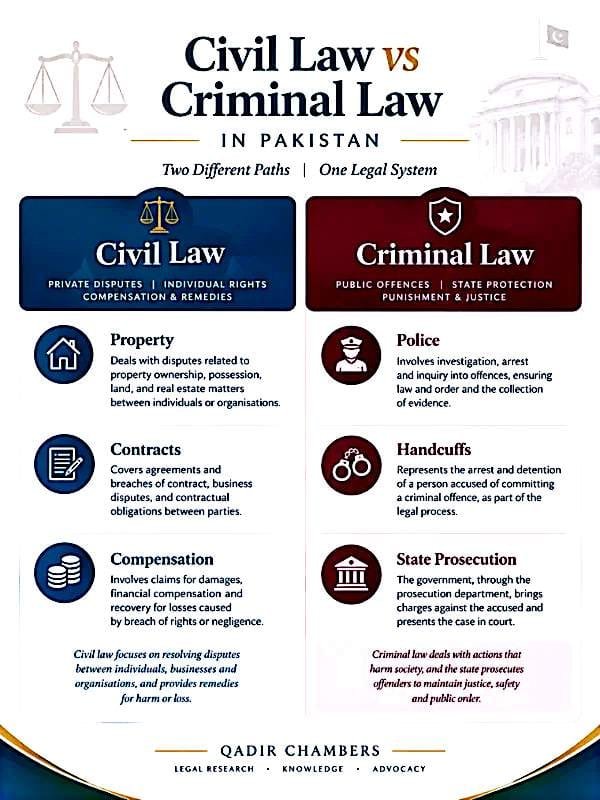
Key Differences: Civil Law vs Criminal Law
Understanding the divergence between these two branches is critical for effective Criminal Defense or civil representation. Below are the fundamental differences categorized by legal standards and procedures.
1. The Burden and Standard of Proof
In the Pakistani legal system, the Qanun-e-Shahadat Order (QSO) 1984 dictates how evidence is presented and who bears the responsibility of proving a fact.
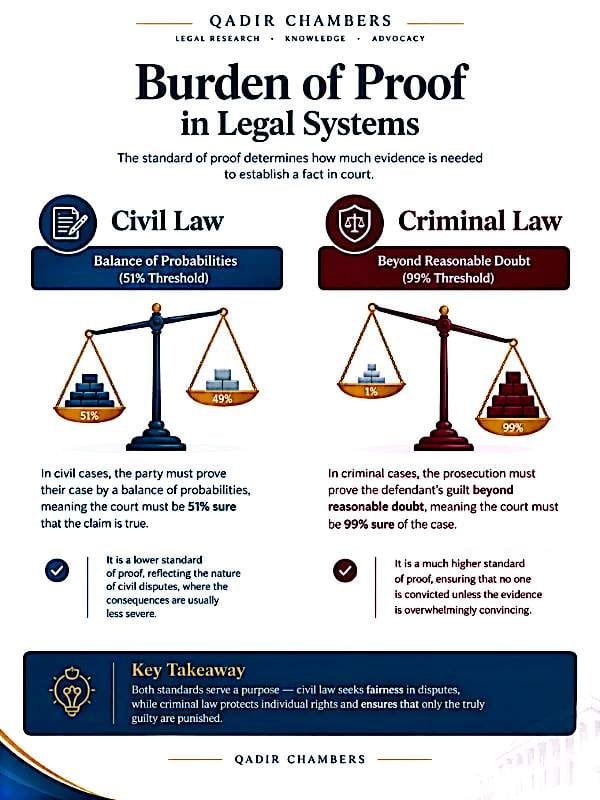
Criminal Standard: Under Article 117 of the QSO, the prosecution must prove the guilt of the accused “beyond a reasonable doubt.” If there is even a slight credible doubt, the benefit of the doubt must be given to the accused, leading to acquittal. This high threshold exists to protect the liberty of citizens.
Civil Standard: In civil cases, the standard is the “balance of probabilities.” The court evaluates which side’s version of events is more likely to be true. If the plaintiff’s evidence is even 51% more convincing than the defendant’s, the plaintiff wins.
2. Parties Involved
In a criminal case, the title of the case usually reads The State vs. [Name of Accused]. The victim is often a witness for the prosecution rather than a party to the suit.
In a civil case, the parties are private entities. A case title would look like [Plaintiff Name] vs. [Defendant Name]. Both parties are responsible for hiring their own Lawyers in Pakistan to represent their interests.
3. Legal Procedures
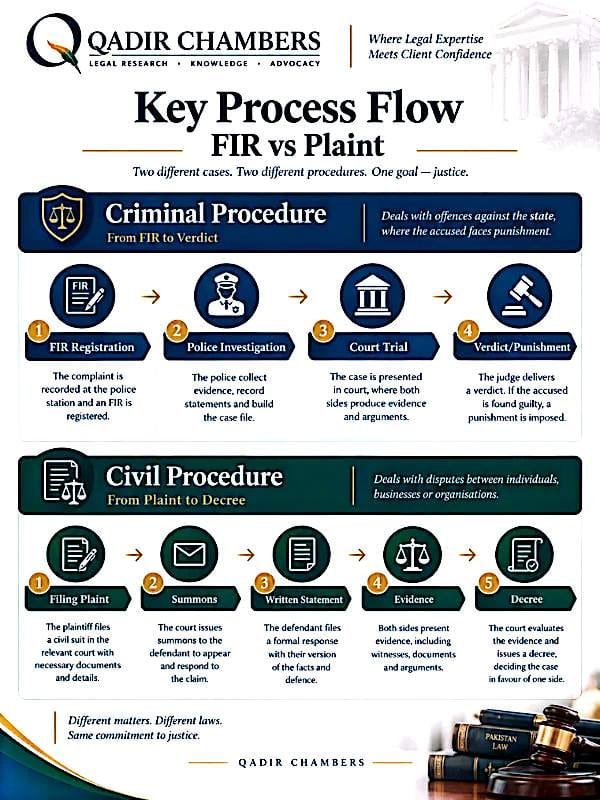
The procedural differences are stark. Criminal cases often begin with the registration of a First Information Report (FIR) under Section 154 of the CrPC. This triggers a police investigation, followed by the filing of a “Challan” (police report) in court.
Civil cases begin with the filing of a “Plaint” (Arzi Dawa) under the CPC. The defendant is then issued a summons to file a “Written Statement.” The process involves the framing of issues, recording of evidence, and final arguments.
4. Remedies and Outcomes
A criminal conviction results in a criminal record and a sentence, such as time in jail. While the court may sometimes order compensation for the victim under Section 544-A of the CrPC, the primary outcome is punishment.
In civil law, the outcome is a “Decree.” This legal document may order the defendant to pay a specific amount of money (damages) or stop a specific action (injunction).
Statutory References in Pakistan
To understand the depth of these laws, one must refer to the official statutes available at the Pakistan Code.
- Pakistan Penal Code (PPC) 1860: The primary document defining crimes like murder (Qatl), theft (Sarqah), and defamation.
- Code of Civil Procedure (CPC) 1908: Regulates the procedure of civil courts and the execution of decrees.
- Code of Criminal Procedure (CrPC) 1898: Sets the rules for the trial of criminal offenses.
- Qanun-e-Shahadat Order (QSO) 1984: The law of evidence that applies to both civil and criminal proceedings, specifically Articles 117 through 119 regarding the burden of proof.
Judicial Precedents and Supreme Court Principles
The Supreme Court of Pakistan has established several landmark principles regarding the separation of civil and criminal liabilities. A common trend in Pakistan is the attempt to convert civil disputes (like a bounced check or a property disagreement) into criminal cases to exert pressure.
The Supreme Court has repeatedly held that “criminal law should not be used as a shortcut to settle civil scores.” If a matter is purely of a civil nature, such as a breach of contract without initial fraudulent intent, the criminal courts should not take cognizance. This principle protects individuals from malicious prosecution.
Comparison Table: Civil vs Criminal Law
| Feature | Criminal Law | Civil Law |
|---|---|---|
| Objective | To punish the offender and maintain social order. | To resolve disputes and compensate the victim. |
| Parties | The State vs. The Accused. | Plaintiff vs. Defendant. |
| Burden of Proof | Beyond a reasonable doubt (Prosecution). | Balance of probabilities (Plaintiff). |
| Primary Statute | PPC 1860 & CrPC 1898. | CPC 1908. |
| Initiation | FIR or Complaint to Magistrate. | Filing a Plaint (Dawa) in Civil Court. |
| Remedy | Imprisonment, Fines, or Death Penalty. | Damages, Injunctions, or Specific Performance. |
| Right of Appeal | Provided under CrPC to High Court/Supreme Court. | Provided under CPC (First and Second Appeals). |
Key Takeaways
- Jurisdiction Matters: Criminal cases are heard in Magistrate or Sessions Courts, while civil cases are heard by Civil Judges.
- Standard of Proof: It is much harder to convict someone of a crime than it is to win a civil lawsuit due to the “beyond reasonable doubt” standard.
- State Involvement: The state provides a prosecutor for criminal trials but remains a neutral arbiter in civil trials.
- Intertwined Cases: Sometimes an action (like a car accident) can result in both a criminal trial (for reckless driving) and a civil suit (for vehicle damages).
- Expert Assistance: Engaging a Qadir Chambers Law Firm professional ensures your case is filed in the correct forum with the right legal strategy.
FAQs
1. Can a person be tried for both civil and criminal law for the same act?
Yes. For example, if someone assaults you, the state can prosecute them under criminal law for the crime of assault, and you can simultaneously sue them in civil court for medical expenses and pain and suffering.
2. Who bears the burden of proof in a civil case?
In civil cases, the burden of proof generally lies with the plaintiff—the person bringing the claim—as per Article 117 of the Qanun-e-Shahadat Order 1984.
3. What happens if a criminal case is not proven beyond a reasonable doubt?
If the prosecution fails to meet this high standard, the court must acquit the accused. In Pakistan, the principle of “presumption of innocence” remains paramount until proven otherwise.
4. Is a lawyer provided by the state in civil cases?
No. In civil cases, you must hire your own legal counsel. In criminal cases, if an accused cannot afford a lawyer, the state may provide a defense counsel at the state’s expense in certain serious crimes.
5. How long do civil cases take compared to criminal cases in Pakistan?
Generally, civil cases in Pakistan take longer due to complex procedural requirements and the heavy backlog in civil courts. Criminal cases involving detained individuals are often prioritized for speedier trials.
6. Can a civil dispute be settled out of court?
Yes, civil cases are frequently settled through Alternative Dispute Resolution (ADR), mediation, or private settlements. Criminal cases (except compoundable offenses) are generally harder to settle privately as they involve the state.
7. What is a “compoundable offense” in Pakistani criminal law?
These are offenses where the victim can “forgive” the offender or reach a settlement, leading to the acquittal of the accused. Common examples include minor injuries or certain property crimes under the PPC.