Copyright Law Definition: Meaning and Legal Scope in Pakistan
Introduction: What Is Copyright Law?
Copyright law definition refers to the legal framework that protects original creative works and grants exclusive legal rights to creators or owners to use, control, reproduce, and distribute their creations. Under this statute, copyright safeguards the specific expression of an idea rather than the underlying idea, concept, or raw factual data itself. In Pakistan, the primary legal foundation governing intellectual property rights in original literature, art, music, dramatics, audio-visual works, and software is the Copyright Ordinance, 1962. Individuals and businesses seeking to protect their creative assets or enforce statutory claims can consult Qadir Chambers, a leading law firm providing comprehensive intellectual property law services and legal representation across Pakistan.
Understanding the legal definition of copyright is vital for authors, digital content creators, software engineers, businesses, media publishers, and academic researchers. Because creative production drives modern commercial markets, copyright law establishes a structured balance between incentivizing original creation and permitting legitimate public access through statutory fair dealing principles.
Copyright Law Definition and Legal Meaning
The statutory meaning of copyright centers on an exclusive legal monopoly created by legislation to protect original mental labor reduced to a tangible medium. Unlike general physical property rights, copyright protects intangible intellectual property. There is a fundamental legal distinction between owning a physical object (such as a printed book or canvas painting) and holding the underlying copyright in the artistic work itself.
Under Pakistani law, Section 3 of the Copyright Ordinance, 1962, defines copyright as an exclusive right to perform, authorize, or prohibit specific acts in respect of a work or any substantial part thereof. These exclusive rights depend strictly on statutory conditions and vary depending on the specific category of protected work.
Crucially, copyright protection strictly adheres to the “idea-expression dichotomy.” Copyright law does not protect:
- Bare ideas, concepts, or raw methodologies.
- Unformatted facts, historical data, or mathematical calculations.
- Short names, slogans, or generic titles (which may instead fall under trademark protection).
Instead, copyright attaches automatically once an author expresses an original idea in a tangible, identifiable form—such as written text, recorded audio, computer code, or visual artwork.
What Does Copyright Law Protect in Pakistan?
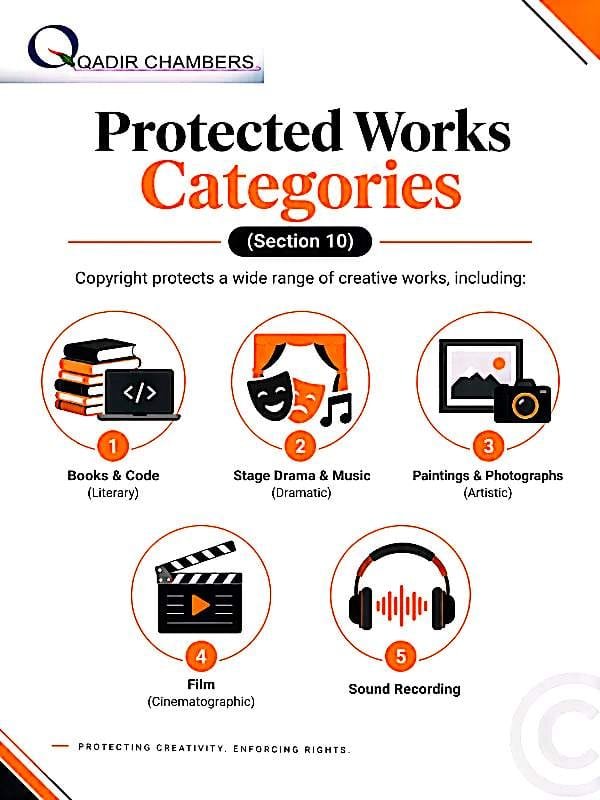
Section 10 of the Copyright Ordinance, 1962, outlines the statutory categories of works in which copyright subsists throughout Pakistan. To qualify for protection, a work must meet the threshold of originality and be expressed in a fixed, tangible format.
Categories of Protected Works:
- Original Literary Works: Books, articles, research papers, scripts, written digital content, databases, and computer software code (source code and object code).
- Dramatic and Musical Works: Stage plays, choreography, musical compositions, arrangements, and accompanying lyrics.
- Artistic Works: Paintings, drawings, architectural designs, engineering diagrams, photographs, graphic designs, and sculptures.
- Cinematographic Works: Feature films, documentaries, video recordings, animations, and commercial video broadcasts.
- Sound Recordings: Audio tracks, podcasts, musical recordings, and spoken word sound files.
It is critical to note that statutory protection depends upon meeting eligibility criteria under the Ordinance. Short business phrases, functional ideas, generic names, and unexpressed concepts do not automatically receive copyright protection under Pakistani law.
Legal Scope of Copyright Law
The legal scope of copyright encompasses a bundle of distinct economic rights granted to the creator or rights holder under Section 3 of the Copyright Ordinance, 1962. These rights grant statutory authority to prevent unauthorized exploitation by third parties.
| Exclusive Right | Description under Section 3 | Practical Example |
|---|---|---|
| Reproduction | Right to copy or print the work in any material form | Publishing copies of a book or duplicating software |
| Publication | Right to issue copies of the work to the public | Distributing physical or digital copies of content |
| Public Performance | Right to perform or display the work publicly | Staging a dramatic play or screening a film broadcast |
| Translation & Adaptation | Right to translate into other languages or alter format | Translating an English novel into Urdu or adapting code |
| Broadcasting | Right to communicate via TV, radio, or digital streams | Streaming audio-visual content across web platforms |
Copyright Ownership and Transfer of Rights
Determining copyright ownership is essential in commercial transactions, employment relationships, and legal proceedings.
1. First Ownership (Section 13)
As a statutory rule under Section 13, the author of a work is the first owner of the copyright. However, key statutory exceptions apply:
- Employment & Contracts of Service: When an employee creates a work during the course of employment under a contract of service, the employer is generally deemed the first owner, subject to any agreement to the contrary.
- Commissioned Works: For commissioned photographs, portraits, or video recordings, first ownership depends on express contractual terms and statutory provisions.
2. Joint Authorship (Section 11)
A work of joint authorship arises when two or more creators collaborate to produce a work in which their individual contributions are not distinct or separate from one another.
3. Assignment and Licensing (Sections 14 & 15)
Copyright owners can transfer or license their rights to third parties:
- Assignment (Section 14): An assignment transfers economic ownership completely or partially. Under Pakistani law, an assignment must be in writing and signed by the assignor or an authorized agent.
- Licensing (Section 15): A license grants permission to use the work under specified conditions while the creator retains underlying legal ownership.
Parties entering corporate transactions or content acquisitions should secure expert contract drafting and review or seek business legal advisory services to ensure rights assignments are legally enforceable.
Is Copyright Registration Necessary in Pakistan?
In Pakistan, copyright protection arises automatically upon the creation and tangible fixation of an original work. Registration with the Copyright Office (under the Intellectual Property Organisation of Pakistan – IPO-Pakistan) is not a mandatory prerequisite for copyright to exist.
However, formal registration provides immense evidentiary advantages:
- Prima Facie Evidence: A certificate of registration issued by the Registrar of Copyrights serves as prima facie evidence of ownership and validity in civil and criminal court proceedings under Section 60.
- Ease of Enforcement: Formal registration greatly simplifies proving ownership when issuing takedown notices, securing interim injunctions, or initiating enforcement actions through law enforcement agencies.
Creators and corporate entities seeking formal registration can consult Qadir Chambers for professional copyright legal advice in Pakistan.
What Constitutes Copyright Infringement?
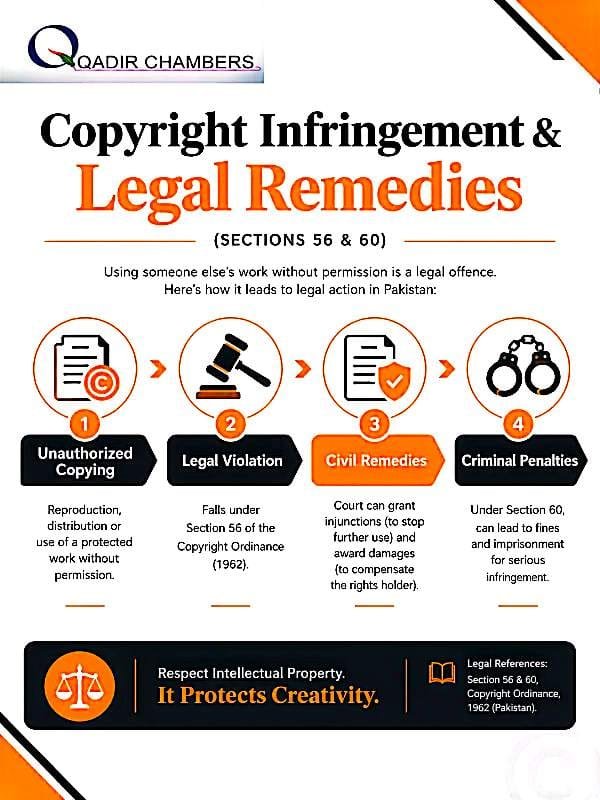
Under Section 56 of the Copyright Ordinance, 1962, copyright infringement occurs when any person, without a valid license or statutory authorization, performs any act the exclusive right to do which is conferred upon the owner of the copyright.
Common Examples of Infringement:
- Digital Plagiarism: Reproducing articles, web pages, or proprietary blog posts without authorization on a competing site.
- Unauthorized Media Usage: Using commercial photographs, graphic designs, or stock images without acquiring proper licenses.
- Software Piracy: Distributing, downloading, or running unauthorized copies of proprietary software programs.
- Unauthorized Translation or Adaptation: Translating a protected book or converting a novel into a film script without written authorization from the copyright holder.
Determining whether an act constitutes infringement requires evaluating the substantiality of the copied portion, authorization status, and available statutory defenses.
Copyright Exceptions and Fair Dealing
Copyright protection is not absolute. Section 57 of the Copyright Ordinance, 1962, establishes specific statutory exceptions where using a protected work without permission does not constitute copyright infringement.
Key Fair Dealing Exceptions:
- Research & Private Study: Fair dealing with any work for the purpose of private study or academic research.
- Criticism & Review: Fair dealing for the purpose of judicial proceedings, criticism, or literary review, accompanied by due acknowledgment.
- Current Events Reporting: Reproducing or reporting news and current events in newspapers, magazines, or broadcasts.
Crucial Legal Note: Merely giving attribution or crediting the original author does not automatically render an infringing use lawful under Pakistani law. Furthermore, statutory fair dealing under the Copyright Ordinance, 1962, differs significantly from the doctrine of “fair use” under United States law.
Copyright Remedies and Legal Consequences in Pakistan
When copyright infringement occurs, the statutory framework provides robust legal remedies accessible through civil litigation and criminal prosecution.
1. Civil Remedies (Section 60 & 60A)
Under Section 60, a copyright owner whose rights have been infringed is entitled to all such remedies by way of injunctions, damages, accounts, and legal costs as are conferred by law.
- Permanent & Interim Injunctions: Restraining the infringing party from further publication or distribution.
- Damages & Account of Profits: Recovering financial losses or profits earned by the infringer.
- Provisional Remedies (Section 60A): Court orders for the seizure and preservation of infringing materials or evidence.
2. Criminal Offences and Penalties (Section 65 & 66)
Under Section 66 and subsequent provisions, intentional copyright infringement, software piracy, and knowingly possessing infringing copies constitute criminal offenses punishable by imprisonment, statutory fines, and seizure of infringing inventory.
Individuals facing copyright disputes can utilize civil litigation services in Pakistan or consult Qadir Chambers for dispute resolution and litigation support.
Important Judicial Decisions on Copyright Law in Pakistan
Pakistani jurisprudence provides key guidance regarding statutory interpretation, procedural requirements, and the jurisdiction of law enforcement authorities in copyright disputes.
Primary Decision: The State v. Muhammad Amin Haroon and others
- Citation & Court: Sindh High Court, Criminal Acquittal Appeal Nos. 202 and 213 of 2008 (Hearing Date: 23 November 2009).
- Official Judgment Access: Sindh High Court Case Law Database.
- Factual Background: Appeals were filed against an acquittal order in criminal proceedings initiated over alleged copyright violations involving recorded content.
- Legal Analysis & Holding: The High Court examined Section 3 (meaning of copyright) and Section 56 (infringement) of the Copyright Ordinance, 1962. The court emphasized the fundamental legal requirement of establishing an identifiable copyrighted work and a clear, verifiable copyright owner or complainant authorized under the law.
- Jurisdictional & Procedural Impact: The judgment evaluated the investigative jurisdiction of the Federal Investigation Agency (FIA) and police officials in copyright matters. The court affirmed that criminal copyright proceedings require strict adherence to statutory search, seizure, and investigative procedures.
Related Precedents Cited in Jurisprudence:
- Murree Brewery Co. Ltd. v. Pakistan (PLD 1972 SC 279): Analyzed broader principles of statutory interpretation and statutory powers of state authorities.
- Iftikhar Hussain v. Government of Pakistan (2001 PCr.LJ 146): Discussed procedural safeguards and administrative jurisdiction during criminal investigations.
- Fazal Dad v. Col. (Rtd.) Ghulam Muhammad Malik (PLD 2007 SC 571): Examined evidentiary standards required when evaluating statutory compliance and jurisdiction.
Copyright Law and Digital Content
The rapid expansion of digital media and artificial intelligence presents modern legal questions under Pakistani copyright law:
- Websites & Digital Publications: Text, design, layout, and graphics published online receive immediate automatic copyright protection upon creation.
- Social Media & Marketing Assets: Re-sharing content on social platforms within platform terms is distinct from copying marketing assets for unauthorized commercial use.
- Software & Code: Computer source code and databases receive statutory protection as literary works under Section 10.
- AI-Assisted & Generative Content: Under existing Pakistani law, copyright protection requires human intellectual effort and authorship. While pure machine-generated content lacks settled statutory precedent in Pakistan, AI-assisted works created with substantial human authorial input may claim protection depending on the facts.
How Can Individuals and Businesses Protect Copyright?
- Maintain Creation Records: Retain original draft files, dated source code commits, design layers, and correspondence proving creation dates.
- Execute Written Contracts: Utilize written employment agreements and vendor contracts containing clear assignment and intellectual property clauses.
- Register Key Creations: File copyright registration applications with IPO-Pakistan for high-value business assets and software.
- Review Digital Licenses: Verify commercial rights before using third-party stock photos, code libraries, or audio files.
- Preserve Infringement Evidence: Take certified screenshots, retain URLs, and document unauthorized commercial usage prior to issuing legal notices.
- Obtain Legal Advice: Consult experienced legal counsel before issuing cease-and-desist letters or initiating court proceedings.
How Qadir Chambers Can Assist
Qadir Chambers provides expert legal guidance across all aspects of copyright and intellectual property law in Pakistan. From filing copyright applications and drafting licensing agreements to defending rights holders in infringement litigation, our team delivers strategic solutions tailored to your commercial objectives.
Whether you require corporate advisory, contract reviews, or copyright infringement legal assistance, consult a law firm in Pakistan with established expertise. Contact Qadir Chambers today to schedule a confidential legal consultation in Pakistan.
Key Takeaways
- Statutory Definition: Copyright protects the tangible expression of an original idea, not the raw idea or concept itself.
- Governing Legislation: The Copyright Ordinance, 1962, serves as Pakistan’s primary copyright law.
- Protected Scope: Broad coverage including literature, software, art, dramatic works, music, films, and audio recordings.
- Automatic Rights vs Registration: Protection arises automatically upon creation, but formal IPO registration provides vital evidentiary advantages.
- Infringement & Remedies: Unauthorized reproduction or commercial distribution triggers civil remedies (injunctions, damages) and criminal prosecution.
- Fair Dealing Limits: Statutory fair dealing exceptions are strictly defined under Section 57; credit attribution alone does not excuse infringement.
Frequently Asked Questions
1. What is the definition of copyright law?
Copyright law is a legal framework that grants creators exclusive legal rights over their original literary, artistic, dramatic, musical, audio-visual, and software works, protecting the tangible expression of ideas from unauthorized reproduction or distribution.
2. What is the main copyright law in Pakistan?
The principal legislation governing copyright law in Pakistan is the Copyright Ordinance, 1962, alongside rules administered by the Intellectual Property Organisation of Pakistan (IPO-Pakistan).
3. What types of works are protected by copyright in Pakistan?
Under Section 10 of the Copyright Ordinance, 1962, protected works include literary works (including computer software), dramatic works, musical compositions, artistic works (photographs, paintings, designs), cinematographic films, and sound recordings.
4. Is copyright registration necessary in Pakistan?
Copyright protection exists automatically upon creation. However, formal registration with IPO-Pakistan is highly recommended as it serves as prima facie evidence of ownership in court proceedings.
5. What is considered copyright infringement?
Copyright infringement occurs under Section 56 when a person reproduces, publishes, performs, translates, or commercially exploits a copyrighted work without the consent or license of the legal copyright owner.
6. What legal remedies are available for copyright infringement in Pakistan?
Under Sections 60 and 66, copyright holders can seek civil remedies, including temporary and permanent injunctions, damages, and accounting of profits, as well as criminal penalties including fines and imprisonment for intentional infringement.
7. Can someone use copyrighted material if they give credit to the original creator?
No. Giving attribution or crediting the original creator does not automatically make an unauthorized commercial or substantial use lawful unless it falls strictly within statutory fair dealing exceptions under Section 57.
Conclusion
Copyright law serves as an essential legal shield for individual creators and corporate entities operating in Pakistan’s creative and digital economies. By establishing exclusive economic rights and clear statutory remedies under the Copyright Ordinance, 1962, the law ensures that original labor is protected against unauthorized exploitation. Whether establishing ownership, drafting commercial contracts, or resolving infringement disputes, seeking professional guidance from Qadir Chambers ensures your intellectual assets remain fully secure.