What Is Copyright Law? Complete Guide to Pakistan’s Law
What Is Meant by Copyright Law?
When considering what is meant by copyright law, it refers to the legal system that grants creators and authors exclusive legal rights to manage, copy, distribute, perform, and adapt their original creative works. Copyright law protects the specific expression of an idea rather than the abstract idea, concept, or raw facts themselves. In Pakistan, the principal statutory framework governing these rights is the Copyright Ordinance, 1962. For individual creators, corporate entities, and developers seeking reliable legal guidance, Qadir Chambers offers expert legal services in Pakistan across all aspects of intellectual property, commercial agreements, and dispute resolution.
Understanding copyright law is essential for businesses, writers, software developers, filmmakers, musicians, and digital content publishers. By protecting original mental labor reduced to a tangible medium, copyright law encourages commercial investment and artistic innovation while establishing clear boundaries for authorized public use through statutory exceptions.
What Is the Legal Definition of Copyright in Pakistan?
Under Section 3 of the Copyright Ordinance, 1962, copyright is defined as an exclusive statutory right to do or authorize the performance of specified acts in respect of a work or any substantial part thereof. These exclusive statutory rights include:
- Reproduction: The right to print, copy, or duplicate the work in any material or digital form.
- Publication: The right to issue and distribute copies of the work to the public.
- Public Performance: The right to perform, recite, or exhibit the work publicly.
- Translation & Adaptation: The right to translate literary works or make adaptations (e.g., converting a book into a film script).
- Broadcasting: The right to stream or broadcast the work via radio, television, or online media.
Copyright is not an absolute or unrestricted monopoly over ideas. Its scope depends on statutory conditions, the nature of the work, legal ownership, contractual licenses, and explicit legal exceptions recognized by statute.
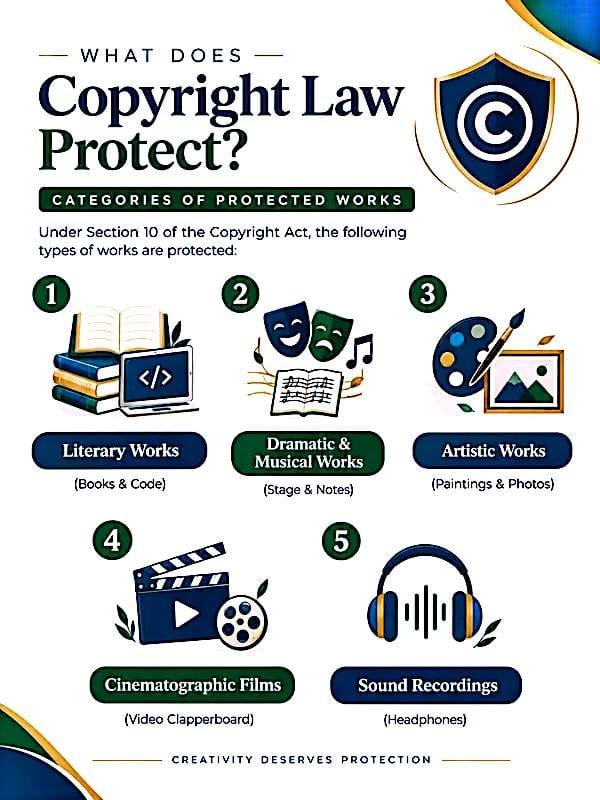
What Does Copyright Law Protect?
Section 10 and Section 2 of the Copyright Ordinance, 1962, establish the statutory categories of works in which copyright subsists throughout Pakistan:
- Literary Works: Books, written articles, research papers, marketing copy, database compilations, and qualifying computer programs (source code and object code).
- Dramatic & Musical Works: Stage plays, choreographic works, musical scores, and song compositions.
- Artistic Works: Paintings, graphic illustrations, photographs, architectural plans, and engineering drawings.
- Cinematographic Works: Feature films, video recordings, commercial broadcasts, and animations.
- Sound Recordings: Podcasts, music tracks, and spoken audio recordings.
Practical Examples of Digital & Business Content Protection:
- Corporate Websites & Blogs: Textual articles, custom graphic designs, and landing page layouts receive individual protection.
- Software & Applications: Source code and software structure are protected as literary works.
- Photography & Media: Marketing photos and promotional video assets fall under artistic and cinematographic works.
Note: Copyright protection requires original creation fixed in a tangible format. Raw facts, unexpressed business ideas, generic titles, or short phrases do not receive independent copyright protection under Pakistani law.
Why Is Copyright Law Important?
Copyright law serves essential commercial and economic functions:
- Commercial Asset Protection: Prevents unauthorized competitors from copying proprietary content, software, or creative collateral.
- Revenue Generation & Licensing: Enables creators to monetize their work through assignments, distribution deals, and royalty-bearing licenses.
- Corporate IP Management: Allows businesses to manage proprietary assets created by employees and third-party contractors.
- Enforceable Legal Remedies: Provides statutory grounds to secure court injunctions and financial damages when infringement occurs.
- Incentivizing Innovation: Assures creators that their time, effort, and capital investment will be legally protected against piracy.
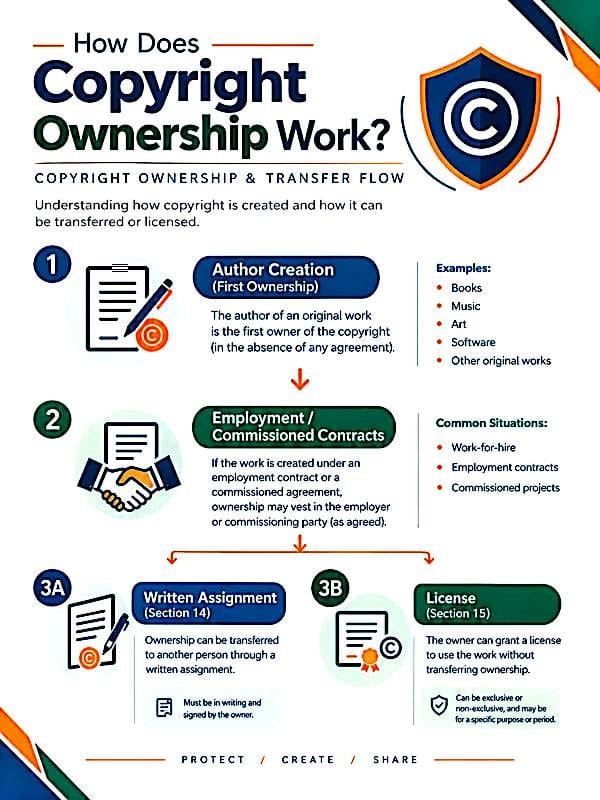
How Does Copyright Ownership Work?
Navigating copyright ownership requires understanding first ownership, joint authorship, assignments, and licensing under Pakistani law.
First Ownership (Section 13)
As a general rule under Section 13, the author of a work is the initial owner of the copyright. However, key statutory exceptions apply:
- Employment (Contracts of Service): Works created by an employee in the course of employment are generally owned by the employer, unless an express contract states otherwise.
- Commissioned Works: Ownership of commissioned photographs, portraits, or recordings depends strictly on express contract terms and statutory rules.
Joint Authorship (Section 11)
When two or more creators collaborate on a work where individual contributions cannot be separated, they hold joint authorship under Section 11.
Assignments vs. Licenses (Sections 14 & 15)
- Assignment (Section 14): A complete or partial transfer of copyright ownership. Under Pakistani law, an assignment must be in writing and signed by the assignor.
- License (Section 15): Grants permission to use the work under defined conditions while the original owner retains legal title.
Purchasing a physical copy of a work (e.g., buying a painting or a book) does not automatically transfer the underlying copyright. Businesses requiring clear IP transfers should engage expert contract drafting and review or seek business legal advisory services.
Is Copyright Registration Required in Pakistan?
However, formal registration offers significant legal advantages:
- Evidentiary Proof: A registration certificate serves as prima facie evidence of ownership and validity in civil and criminal court proceedings under Section 60.
- Simplified Enforcement: Facilitates issuing takedown notices, securing interim court injunctions, and proving rights in commercial transactions.
Entities seeking registration can consult Qadir Chambers for expert copyright legal advice in Pakistan and intellectual property law services.
What Is Copyright Infringement?
Under Section 56 of the Copyright Ordinance, 1962, copyright infringement occurs when any person performs an exclusive act reserved for the copyright owner without obtaining a valid license or statutory authorization.
Common Examples of Infringement:
- Copying and publishing website articles or blog posts without permission.
- Utilizing stock photos, graphic designs, or music tracks outside license parameters.
- Distributing unauthorized copies of proprietary software or video recordings.
- Translating or adapting copyrighted books or scripts without authorization.
Determining infringement requires evaluating the substantiality of the copied work, license terms, authorization, statutory exceptions, and available evidence.
Copyright Exceptions and Fair Dealing
Section 57 of the Copyright Ordinance, 1962, establishes statutory exceptions where using a protected work without consent does not constitute infringement.
Qualifying Fair Dealing Purposes:
- Private Study & Academic Research: Personal study and educational analysis.
- Criticism & Review: Reviewing or criticizing a work, provided proper acknowledgment is given.
- Current Events Reporting: Reporting news events in print, broadcast, or online media.
Important: Crediting or attributing the original author does not automatically convert an unauthorized commercial use into a lawful use. Furthermore, Pakistan’s statutory “fair dealing” provisions differ significantly from the US “fair use” doctrine.
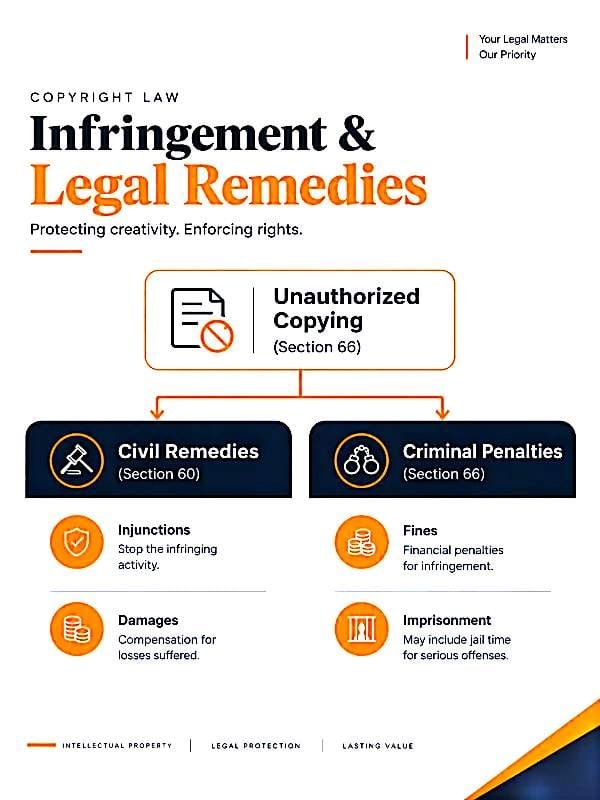
Copyright Remedies and Legal Consequences in Pakistan
When copyright infringement is established, Pakistani law provides civil remedies and criminal penalties through the court system.
1. Civil Remedies (Sections 60 & 60A)
Under Section 60, copyright owners can pursue:
- Interim & Permanent Injunctions: Restraining the infringing party from further publication or sale.
- Damages & Account of Profits: Recovering financial losses or profits made through unauthorized exploitation.
- Provisional Orders (Section 60A): Court orders to seize and preserve infringing goods or evidence.
2. Moral Rights (Section 62)
Section 62 protects the author’s moral rights, including the right to claim authorship and object to unauthorized distortions or modifications prejudicial to their honor or reputation.
3. Criminal Offences & Penalties (Section 66 onwards)
Intentional copyright infringement and software piracy constitute criminal offenses under Section 66, carrying potential penalties of imprisonment, statutory fines, and seizure of infringing materials.
Parties involved in rights disputes can utilize civil litigation services in Pakistan or consult Qadir Chambers for dispute resolution and litigation support.
Important Judicial Decisions on Copyright Law in Pakistan
Pakistani courts regularly interpret statutory copyright provisions and enforce procedural requirements.
Primary Case: The State v. Muhammad Amin Haroon and others
- Citation & Court: Sindh High Court, Criminal Acquittal Appeal Nos. 202 and 213 of 2008 (Hearing Date: 23 November 2009).
- Official Judgment Source: Sindh High Court Case Law Database.
- Factual & Procedural Background: Appeals arising from acquittal orders in criminal proceedings regarding alleged unauthorized distribution of copyrighted content.
- Holding & Judicial Analysis: The High Court examined Sections 3 and 56 of the Copyright Ordinance, 1962. The court underscored that criminal copyright enforcement requires clear identification of the protected work and a legally authorized complainant.
- Jurisdictional Significance: Evaluated the investigative jurisdiction of the Federal Investigation Agency (FIA) and local police, confirming that statutory procedure must be strictly followed in copyright prosecutions.
Related Precedents Cited in Jurisprudence:
- Murree Brewery Co. Ltd. v. Pakistan (PLD 1972 SC 279): Established fundamental principles governing statutory interpretation and administrative powers.
- Iftikhar Hussain v. Government of Pakistan (2001 PCr.LJ 146): Addressed procedural compliance and law enforcement authority during investigations.
- Fazal Dad v. Col. (Rtd.) Ghulam Muhammad Malik (PLD 2007 SC 571): Examined evidentiary standards in administrative and statutory proceedings.
Copyright Law in the Digital Age
Digital technology creates complex copyright issues across various sectors:
- Websites & Digital Copy: Online text, code, and graphics receive immediate protection upon creation.
- Social Media Assets: Sharing content on platform feeds is governed by platform terms, whereas re-using third-party assets for commercial ads requires explicit licenses.
- Software & Digital Products: Computer code is protected as a literary work; unauthorized distribution violates Section 56.
- AI-Assisted Content: Under current Pakistani law, copyright protection requires human intellectual effort. Purely machine-generated content lacks settled statutory precedent, whereas human-directed AI works may claim protection based on individual facts.
How Can Individuals and Businesses Protect Copyright?
- Keep Creation Logs: Maintain original project files, draft manuscripts, source code commits, and dated records.
- Execute Written Contracts: Ensure all employee and contractor agreements contain clear IP assignment clauses.
- Secure Formal Registration: Register key software, publications, and brand content with IPO-Pakistan.
- Audit Third-Party Licenses: Review commercial licensing terms before using stock photos, fonts, or code libraries.
- Document Infringement: Preserve certified digital evidence, URLs, and screenshots before issuing formal legal notices.
- Consult Legal Counsel: Seek professional advice before sending cease-and-desist letters or initiating litigation.
How Qadir Chambers Can Help
Qadir Chambers provides end-to-end legal support for individuals, businesses, and creators. Our legal team assists with IP registrations, contract drafting, licensing, and enforcing copyright claims in court.
Whether you need copyright infringement legal assistance, guidance on corporate IP structure from our commercial law services, or wish to consult a qualified legal professional, contact Qadir Chambers for a comprehensive legal consultation in Pakistan. You can also meet the legal team to learn more about our experienced practice.
Key Takeaways
- Expression Protection: Copyright law protects the tangible expression of creative works, not abstract ideas or raw facts.
- Governing Ordinance: The Copyright Ordinance, 1962, is the primary statute in Pakistan.
- Broad Scope: Covers literature, software, dramatic works, music, art, films, and sound recordings.
- Automatic Rights: Copyright exists upon creation, though IPO-Pakistan registration provides vital evidence in court.
- Infringement & Penalties: Unauthorized use triggers civil remedies (injunctions, damages) and potential criminal penalties.
- Fair Dealing: Statutory exceptions are narrow; crediting the author does not excuse unauthorized commercial exploitation.
Frequently Asked Questions
1. What is meant by copyright law?
Copyright law is a legal system that grants authors and creators exclusive legal rights over their original works, protecting the tangible expression of ideas from unauthorized copying, publication, or adaptation.
2. What is the legal definition of copyright in Pakistan?
Under Section 3 of the Copyright Ordinance, 1962, copyright is an exclusive statutory right to perform or authorize specific acts—such as reproduction, publication, performance, translation, and broadcasting—in respect of a protected work.
3. What types of works are protected by copyright law?
Under Section 10 of the Copyright Ordinance, 1962, protected categories include literary works (including software), dramatic works, musical works, artistic works, cinematographic films, and sound recordings.
4. Is copyright registration necessary in Pakistan?
No, copyright protection exists automatically upon creation. However, formal registration with IPO-Pakistan serves as valuable prima facie evidence of ownership in legal disputes.
5. What is the difference between copyright ownership and a copyright licence?
Copyright ownership gives full title and exclusive rights over the work, whereas a copyright license merely grants permission to use the work under specified conditions while the licensor retains legal ownership.
6. What counts as copyright infringement in Pakistan?
Under Section 56, infringement occurs when a party reproduces, publishes, translates, or commercially exploits a copyrighted work without the owner’s valid consent or license.
7. What legal remedies are available for copyright infringement?
Civil remedies under Section 60 include injunctions, damages, and accounting of profits. Criminal penalties under Section 66 include fines and imprisonment for willful infringement.
Conclusion
Copyright law plays a vital role in protecting creative talent, software innovation, and corporate brand value in Pakistan. By granting exclusive statutory rights and enforceable remedies under the Copyright Ordinance, 1962, the law ensures that creators and businesses can safely monetize their work. When dealing with complex ownership contracts or potential infringement disputes, consulting experienced legal counsel at Qadir Chambers ensures your legal rights remain fully protected.