Copyright Law in Pakistan: Registration, Rights & Legal Enforcement
1. Introduction to Copyright Law in Pakistan
Navigating Copyright Law in Pakistan is vital for creators, enterprise businesses, software developers, and media entities seeking to safeguard their original intellectual property. Copyright protection in Pakistan arises automatically upon the creation of an original work, yet formal registration provides indispensable evidentiary advantages during enforcement. The primary statute governing these rights is the Copyright Ordinance, 1962, administered by the Intellectual Property Organization of Pakistan (IPO-Pakistan). Understanding how to secure registration and pursue remedies against unauthorized reproduction ensures robust asset protection in dynamic commercial markets. Authors and businesses can consult Qadir Chambers Law Firm to implement effective legal strategies for asset protection.
Securing dynamic commercial assets requires careful strategic planning. Legal guidance from experienced Copyright Lawyers in Pakistan helps rightsholders establish priority, commercialize assets through licensing, and defend against unlawful exploitation across domestic and cross border jurisdictions.
2. What Works Are Protected under Pakistani Copyright Law
Under Section 10 of the Copyright Ordinance, 1962, copyright subsists in original works across multiple creative and technical disciplines. To qualify for statutory protection, a creation must be original, reduced to a tangible medium, and fit within recognized categories defined by law.
Categories of Protected Works
- Literary Works: Novels, poems, research papers, articles, instruction manuals, tables, and compilations. Computer programs, source codes, and software algorithms are explicitly protected as literary works under statutory amendments.
- Dramatic Works: Plays, choreographic works, mime shows, and scenic arrangements fixed in writing or notation.
- Musical Works: Musical compositions, written scores, and accompanying arrangements, excluding words or actions intended to be sung or spoken.
- Artistic Works: Paintings, drawings, sculptures, architectural designs, blueprints, photographs, maps, charts, and original graphic layouts.
- Cinematographic Works: Motion pictures, feature films, documentaries, video recordings, and sound tracks synchronized with visual sequences.
- Recordings: Audio sound recordings, podcasts, and spoken performances stored in physical or digital formats.
The Idea versus Expression Dichotomy
Under statutory principles and judicial precedents, copyright protection extends strictly to the expression of an idea, not to the underlying idea, system, procedure, or operational concept itself. A software program’s unique source code is protected, whereas the abstract functional concept behind the software remains unprotected unless secured under patent legislation.
3. Copyright Ownership and Authors Economic and Moral Rights
Establishing original ownership is the cornerstone of intellectual property strategy. Section 13 of the Copyright Ordinance, 1962 lays down the fundamental rule: the author of a work shall be the first owner of the copyright.
Exceptions to First Ownership
- Works Made in the Course of Employment: When a literary, dramatic, artistic, or software work is created by an employee during the normal scope of employment, the employer is deemed the first owner, absent any contract to the contrary.
- Commissioned Works: For commissioned photographs, portraits, engravings, or cinematographic works made for valuable consideration, the commissioning party generally holds ownership unless contractually agreed otherwise.
- Government Publications: Works created or published under the direction or control of public agencies vest initial copyright in the government.
To ensure clarity regarding proprietary ownership in corporate structures, obtaining tailored Intellectual Property Legal Services is recommended when drafting employment and vendor contracts.
Economic Rights of the Owner
Section 3 of the Ordinance grants exclusive economic rights to the copyright owner. These rights permit the owner to authorize or restrict the following actions:
- Reproducing the work in any material or digital form.
- Publishing and distributing copies to the public.
- Performing or broadcasting the work publicly.
- Translating, adapting, or creating derivative works based upon the original creation.
- Renting or commercially leasing software programs and sound recordings.
Moral Rights of the Author
Independent of economic rights, Section 62 of the Ordinance protects the author’s moral rights, which remain attached to the creator even after complete assignment of economic ownership:
- Right of Paternity (Attribution): The right to claim authorship of the work and be identified as the creator.
- Right of Integrity: The right to restrain or claim damages for any distortion, mutilation, or modification of the work that causes prejudice to the author’s honor or reputation.
Duration of Copyright Protection
According to Section 14 of the Copyright Ordinance, 1962, copyright in literary, dramatic, musical, and artistic works published within the lifetime of the author subsists for the lifetime of the author plus 50 years following the calendar year of their death. For joint authorship, the 50-year post-mortem period runs from the death of the last surviving author.
For cinematographic works, sound recordings, government works, and anonymous publications, copyright protection lasts for 50 years from the beginning of the calendar year following the year the work was first published.
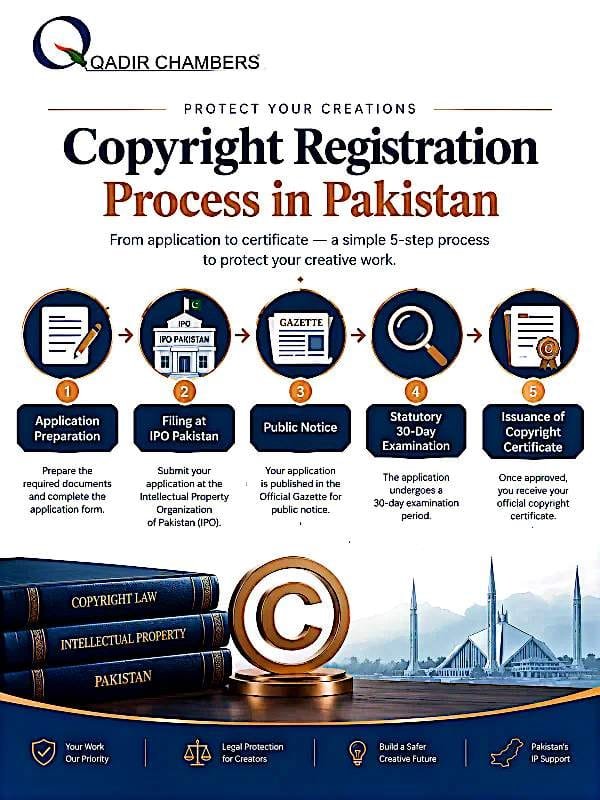
4. Copyright Registration Process in Pakistan
Although copyright arises automatically upon creation, registering a work with the Copyright Office of IPO-Pakistan yields immense evidentiary benefits in infringement litigation.
Step by Step Registration Workflow
[Prepare Application & Documents] ➔ [Submit Form II to Copyright Office] ➔ [Public Notice & 30-Day Objection Period] ➔ [Substantive Examination by Registrar] ➔ [Issuance of Registration Certificate]
Step 1: Document Preparation
Applicants must compile Form II in triplicate, complete schedule descriptions, provide copies of the work, and pay prescribed official fees. Software applications require submitting representative source code excerpts.
Step 2: Public Notice
The applicant must publish a public notice of the application in a national daily newspaper at their own expense if requested by the Copyright Registrar, or serve notice upon any third party holding an interest in the work.
Step 3: Waiting Period for Objections
A mandatory 30-day waiting period follows public notification. Any party claiming prior rights or alleging plagiarism may file formal objections with the Registrar of Copyrights.
Step 4: Examination
If no objections are received within 30 days, the Registrar conducts a substantive examination to ensure compliance with originality requirements, statutory formalities, and public policy guidelines.
Step 5: Final Registration
Upon satisfaction, the Registrar enters particulars into the Register of Copyrights and issues an official Certificate of Registration under the seal of the Copyright Office.
Complex IP applications often benefit from skilled oversight via Intellectual Property Law practices to prevent procedural rejections or procedural delays.
5. Registered vs Unregistered Works Comparison
The following table highlights the critical operational differences between relying on common-law copyright vs securing formal statutory registration in Pakistan.
| Aspect | Registered Works in Pakistan | Unregistered Works in Pakistan |
|---|---|---|
| Legal Protection Basis | Statutory rights under Copyright Ordinance, 1962 with entry in Register of Copyrights. | Common law rights automatically created upon fixing the work in tangible form. |
| Burden of Proof | Prima facie presumption of ownership shifts burden of proof onto the alleged infringer. | Strict burden on creator to prove original creation date, chain of custody, and authorship. |
| Evidentiary Value | Certified copies from Copyright Registry are admissible directly in court under Section 60. | Requires extensive corroborative evidence, expert witnesses, and historical electronic logs. |
| Enforcement Mechanism | Immediate access to interim injunctions, criminal police raids, and statutory damage claims. | Higher standard of proof required before courts grant interlocutory injunctions or criminal relief. |
| Commercial Monetization | Simplifies licensing, cross border transfers, banking transactions, and asset valuation. | Complex due diligence required by potential investors or commercial licensees. |
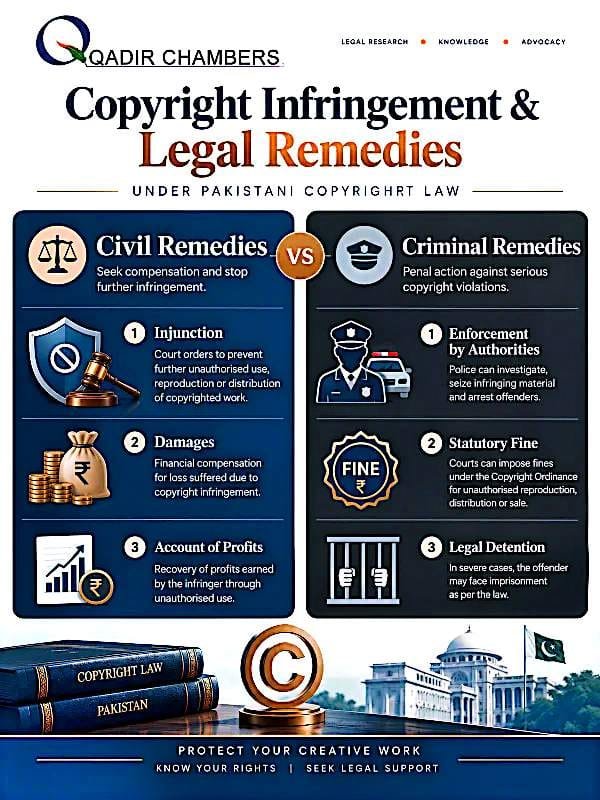
6. Copyright Infringement and Enforcement
Section 56 of the Copyright Ordinance, 1962 defines infringement as performing any act reserved exclusively for the copyright owner without obtaining a valid license or written authorization.
Common Instances of Infringement
- Making unauthorized digital or physical copies of protected literary, artistic, or software works.
- Distributing pirated software code, online media, or educational textbooks.
- Publicly broadcasting or streaming television broadcasts, musical compositions, or films without authorization.
- Creating unauthorized translations, adaptations, or derivative works for commercial gain.
Civil Remedies
Copyright owners can file civil lawsuits in District Courts or High Courts possessing original jurisdiction. Civil remedies under Section 60 include:
- Interlocutory & Permanent Injunctions: Restraining the infringer from continuing unauthorized distribution, sale, or reproduction.
- Account of Profits or Damages: Recovery of actual monetary losses suffered by the rightsholder or disgorgement of profits earned unlawfully by the infringer.
- Delivery Up & Destruction: Orders requiring seizure, confiscation, and destruction of infringing copies, plates, molds, and manufacturing equipment.
For complex high stakes litigation, seeking robust representation through experienced counsel skilled in Civil Litigation ensures urgent interim relief is secured efficiently.
Criminal Penalties and Police Enforcement
Section 66 of the Copyright Ordinance, 1962 classifies intentional copyright infringement as a punishable criminal offense. Criminal proceedings can run parallel to civil lawsuits.
- Imprisonment: Penalties may extend up to three years of imprisonment.
- Fines: Statutory fines reach up to PKR 100,000 for standard violations, with higher penalties for repeat offenders.
- Seizure of Infringing Goods: Under Section 74, police officers not below the rank of Sub-Inspector hold statutory powers to seize infringing copies and equipment used in unauthorized reproduction without a warrant, upon reasonable belief of infringement.
Customs Interdiction and Import Controls
Section 39 enables copyright owners to notify Pakistan Customs authorities regarding expected importations of pirated goods. Customs officers hold authority to detain, inspect, and confiscate unauthorized imported consignments at international ports.
When dealing with corporate entities engaging in systematic commercial piracy, initiating comprehensive action under Commercial Law or seeking dynamic corporate strategies through experienced counsel specializing in Corporate Law can accelerate asset recovery and corporate resolution.
7. Relevant Laws and Judicial Decisions
Copyright protection in Pakistan interacts with multiple statutory provisions, evidentiary frameworks, and judicial interpretations.
Statutory Interconnections
Primary statutory texts can be reviewed directly via the Pakistan Code. The copyright legal framework works alongside:
- Pakistan Penal Code (PPC): Provisions governing fraud, forgery, and dishonest misappropriation of property.
- Qanun-e-Shahadat Order, 1984: Governs rules of evidence, admissibility of certified public records, and electronic evidence authentication.
- Prevention of Electronic Crimes Act (PECA), 2016: Addresses unauthorized access, digital piracy, and cyber crimes involving digital media assets.
Official statutory enforcement policies and registry rules are maintained directly by IPO Pakistan.
Key Judicial Precedents
Judicial interpretation by Pakistani courts has shaped enforcement paradigms:
- Evidentiary Weight of Registration: Courts, including rulings archived within the Sindh High Court Case-Law Database, consistently affirm that while registration is optional, a Certificate of Registration establishes a strong legal presumption of ownership, greatly simplifying the burden of proof in injunction applications.
- Fixation and Originality Standards: Decisions from the Supreme Court of Pakistan emphasize that law protects labor, skill, and judgment expended in reducing an original idea into tangible expression. Merely copying public domain information without minimal creativity does not warrant protection.
- Corporate Liability for Unlicensed Software: High Courts have repeatedly held corporate executives liable for deploying unlicensed software across company networks, establishing that corporate use of pirated software constitutes actionable commercial infringement.
8. Practical Protection Steps for Businesses and Creators
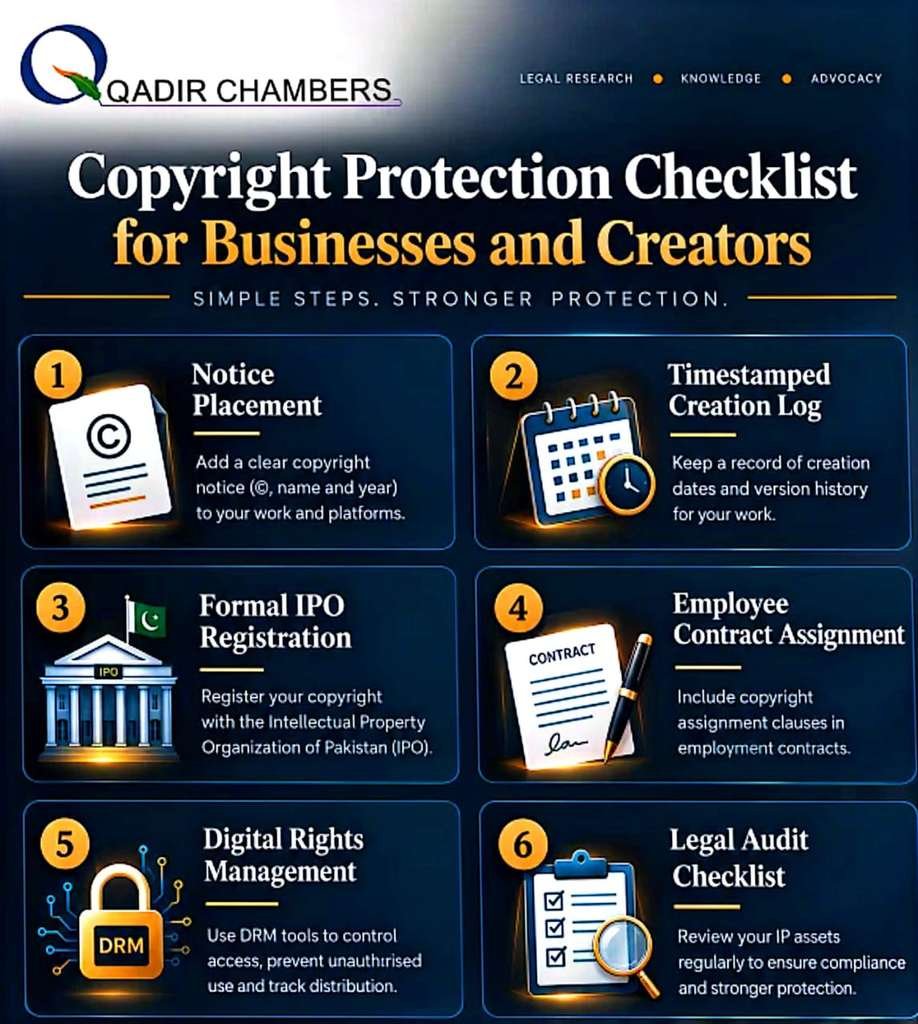
Protecting intellectual assets requires combining practical administrative security with formal legal processes.[Deploy Copyright Notices] ➔ [Maintain Complete Creation Logs] ➔ [Register Key IP Assets with IPO] ➔ [Execute Non-Disclosure & IP Agreements] ➔ [Monitor & Enforce Violations]
Actionable Strategy Checklist
- Affix Proper Copyright Notices: Display explicit ownership tags on all published materials, websites, and software interfaces (e.g., “Copyright © 2025 [Owner Name]. All Rights Reserved.”).
- Maintain Systematic Development Logs: Keep timestamped physical and digital records of early sketches, draft outlines, design revisions, and source code repositories to establish priority dates.
- Execute Employment and Vendor Agreements: Ensure all employment contracts, independent contractor agreements, and software vendor terms contain clear intellectual property assignment clauses transferring initial ownership to the company.
- Promptly Register Core Intellectual Assets: File formal applications with the Copyright Office of IPO-Pakistan for key proprietary software, original training manuals, commercial designs, and corporate media content.
- Implement Digital Rights Management (DRM): Utilize encryption, digital watermarking, and access restriction protocols to restrict unauthorized copying or sharing of proprietary digital files.
- Schedule Regular Legal Audits: Engage qualified experts for routine compliance checks and structured Legal Consultation to audit corporate software usage, content distribution channels, and licensing portfolios.
9. Key Takeaways
- Automatic Protection vs Registration: Copyright exists upon creation, but formal registration with IPO-Pakistan provides essential prima facie legal evidence during enforcement disputes.
- Scope of Coverage: Copyright protects original literary, dramatic, musical, artistic, software, and audio visual expressions, but does not cover abstract ideas or functionality.
- Owner Economic and Moral Rights: Rightsholders retain exclusive rights to reproduce, distribute, perform, and adapt works, while original authors retain immutable moral rights of attribution and integrity.
- Dual Enforcement Channels: Violations can be prosecuted through civil courts for damages and injunctions, or through criminal proceedings involving police raids, seizures, fines, and potential imprisonment.
- Proactive Contractual Security: Companies must ensure all internal and external contributor contracts contain clear, enforceable IP assignment terms.
10. Frequently Asked Questions (FAQs)
1. Is copyright registration mandatory in Pakistan?
No, copyright protection in Pakistan is automatic as soon as an original work is created and fixed in a tangible format. However, registering your work with IPO-Pakistan is highly recommended because it provides prima facie evidence of ownership, making it significantly easier to enforce your rights in court.
2. How long does copyright protection last under Pakistani law?
For literary, artistic, musical, and dramatic works, copyright lasts for the author’s entire lifetime plus 50 years after their death. For cinematographic films, sound recordings, government publications, and corporate works, copyright lasts for 50 years from the end of the year in which the work was first published.
3. Can software programs and mobile apps be protected under copyright in Pakistan?
Yes, software source codes, object codes, software architecture, and mobile applications are explicitly protected as literary works under the Copyright Ordinance, 1962. Software developers can register their source codes to protect against unauthorized copying, reverse engineering, and piracy.
4. What is the difference between copyright and trademark in Pakistan?
Copyright protects original creative and intellectual expressions such as books, music, art, software, and films. A trademark protects brand identifiers like brand names, logos, slogans, and trade dress used to identify goods or services in the commercial marketplace.
5. What remedies are available if someone steals my copyrighted content?
You can file a civil lawsuit to obtain immediate temporary or permanent injunctions, recover actual financial damages or an account of profits, and secure orders for the seizure and destruction of infringing goods. You can also pursue criminal proceedings, which may result in police raids, criminal fines, and imprisonment for the infringer.
6. Who owns the copyright for work created by an employee or contractor?
If an employee creates a work as part of their regular job duties, the employer is generally considered the legal owner of the copyright, unless an agreement states otherwise. For independent contractors, the contractor usually retains copyright ownership unless a written contract explicitly assigns all intellectual property rights to the hiring client.
7. How are fair use principles handled under Pakistani Copyright Law?
Section 57 of the Copyright Ordinance, 1962 provides specific statutory exceptions where using copyrighted material without permission is not considered infringement. This includes fair dealing for private study, non commercial research, criticism, news reporting, judicial proceedings, and educational instruction.
11. Legal Disclaimer
This legal article is provided for informational and educational purposes only and does not constitute formal legal advice. Readers should not act or refrain from acting based upon any information contained herein without seeking professional legal counsel tailored to their specific circumstances. Engaging with this document or reaching out for general information does not establish an attorney-client relationship.